-
Dark Angels Successors Chapters
I’ve written before about heraldry and markings for Dark Angels Space Marines in Warhammer: 40,000. Today I’ll go over successor chapters. There are a number of named chapters that Games Workshop has developed, so you’re free to use one of those, or make up a new one entirely.
Organization
Some Dark Angels successor chapters are going to hew closely to how the parent chapter is organized and operates. Some could be totally different. There are even brand new Ultima Founding chapters that don’t even know anything about the Fallen and just go about doing normal Space Marine things.
By default I would recommend that your chapter follow the Codex Astartes, or a modified version like the Dark Angels use—ten companies of 100 marines plus command personnel. Whether you use colored helmets and company colors or Dark Angels-style heraldic devices is up to you.
Note that successor chapters that use Dark Angels-style kneepads to designate their companies tend to use the model’s right kneepad (not left).
Your chapter can have Deathwing or Ravenwing analogues, but it doesn’t need to. Perhaps your chapter master distributes knowledge of the Fallen throughout the companies to trusted veteran sergeants. In-game you’ll still only get the Deathwing keyword on the appropriate squads, but the story is yours to make up. Likewise with the Ravenwing. You can have the bikes be part of normal companies, not all grouped together in the 2nd.
Colors
Successor Terminators and bikes can be the same color as the rest of your army; they don’t need to be different like with the Dark Angels. If you do want to give them their own color schemes, I recommend picking your palette with this in mind. Use the secondary color on the main troopers as the primary color on the veterans. Or just mark your Deathwing-equivalent with, say, gold trim instead of black. There are plenty of ways to distinguish them.
The Unforgiven
2nd edition Angels of Death codex:
The three Space Marine Chapters shown here and the Dark Angels Chapter comprised the original Dark Angels Legion before the Second Founding. […] Collectively the four Chapters are known as the Unforgiven. The Angels of Absolution, the Angels of Vengeance and the Angels of Redemptionm share the ancient secret of the Dark Angels and that Chapter’s mission to reclaim its honour and eradicate the terrible shame of their part in the history.
The three Chapters follow the Dark Angels’ pattern of organization closely and each has its own Inner Circle. They all have formations which are similar to the Deathwing and Ravenwing companies although they are not named as such. The Chapters of the Unforgiven coordinate their activites in regard of their secret mission and it is not unknown for the Supreme Grand Masters of the four Chapters to hold summit meetings on the Rock.
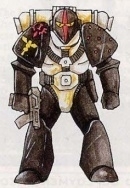
Angels of Absolution: Accoding to Angels of Death, “all of the Chapter’s warriors wear bone-white armour.” This would include its Deathwing and Ravenwing analogues. Their robes are green. Their backpacks are black in earlier codex art but white in some. Their inner circle is called the Hidden Brotherhood.
Angels of Vengeance: “The First Company wears black Terminator armour and the monkish robes of the Inner Circle are jet-black.” Some GW studio models have red tabards. Squad markings are inverted from Dark Angels—white with red numbers. “The Angels of Vengeance use a Terminator-armoured company known as the Dreadwing and a mobile Raptorwing to carry out the hunt for the Fallen (8th ed codex, page 45).
Angels of Redemption: Red Robes. “The Angels of Redemption have the Redwings, their 1st and 2nd companies” (ibid).
Other Named Successors
Guardians of the Covenant wear red robes. Their bikers use the same silver colors as their battle companies, with some red panelling. Very monastic in their styling—probably hard to do these days without Primaris-sized robes but one could maybe use Black Templar pieces. Their inner circle is known as the Secret Order.
Consecrators used to only wear MK VI armor but now have Primaris members. Their robes are red. Squad markings are inverted from Dark Angels—white with red numbers. Terminators wear white helms per the novel The Unforgiven.
Disciples of Caliban’s Terminators wear the same green and black as their battle company do. They have lots of relics so I’d recommend some cool ancient conversions. White/bone robes.
Angels of Defiance have quartered black and bone armor. Black on the models' upper-left and lower-right, bone on the top-left and bottom-right. Green robes.
That’s just a few of the ones GW has made up. If I were starting over I’d probably so a codex-style chapter with black armor like the Heresy scheme. For ease I’d likely also try to use regular SM models so that I wouldn’t have to source chapter-specific parts.
More in this series:
- Shoulder Pads of the Dark Angels
- Dark Angels Apothecaries
- Why the Dark Angels Really Changed from Black to Green?
- How the Dark Angels story developed, from Rogue Trader to 2nd edition
- Successor Chapters
- My 4th company, “The Feared”
- The Deathwing: History and Complement
- Dark Angels Decals: A Look at Waterslide Transfer Sheets
- The Ravenwing, the Dark Angels' Cavalry
- Dark Angels Painting “Mistakes”
-
Teammate 1.0.1
Teammate 1.0.1 is available now.
The big features are enhancements for people who primarily do Matched Play games, and list validation.
When you create a new team, you can now choose whether your roster will be used for Matched Play or for Spec Ops. If you pick Matched Play, the app will hide all the Spec Ops features and will just let you make a list and keep score in games. I think that for basic Kill Team list-building and sharing it’s the best option out there.
List validation (for non-Compendium teams) means that when you create a new Spec Ops team, the app will make sure your starting roster is legal. If your team only allows you to take a certain number of a given operative (ex. one leader, one plasma gunner), Teammate will disable the ability to select more once you’ve hit your limit. This also works when you start a game—start selecting operatives and invalid choices will dim. You can turn this off if you don’t want it, which might be needed if you’ve written a narrative scenario requiring something unusual.
Tac Ops scoring has been improved a little, too. Some cards, like Rob & Ransack, require the operative who scored to the first bullet point to also score the second. In this case, the second bullet is now a toggle switch, which prevents you from assigning that point to the wrong operative. Other cards, like a few for Warpcoven, can only be scored by a specific operative type. The list now limits itself to just valid operatives. And for Matched Play rosters, Tac Op scoring is just a series of switches now. No need to designate the operative who scored it, since XP isn’t a factor.
Going forward, should an operative pay the ultimate price and roll a 1 for its battle scar test, you can visit the “In Memoriam” page to remmeber their sacrifice. There’s even a notes field where you can fill in some details aobut your departed operative’s demise.
New Spec Ops teams can also set custom campaign rules to increase XP generation and/or decrease the XP needed to level up.
Release notes:
- Matched play teams: When you create a new team you can now designate it as a Matched Play list, which will hide all Spec Ops features.
- List validation: New non-Compendium rosters will now prevent you from taking an illegal initial list.
- Pre-game team selection: Added an option to validate the list as you select operatives.
- Custom campaign rules: When creating a Spec Ops team you can now adjust how much XP operatives get in a game and/or how quickly they gain ranks.
- “In Memoriam”: Slain operatives now have a resting place in the team’s Info section. (This only collects operatives slain since upgrading to this version.)
- Tac Ops: Cards that are “all or nothing” will now automatically fill in both bullet points when scored (Interloper, Plant Signal Beacon, Blow It Up!)
- Tac Ops: Cards that require the same operative to score both points will now prevent you from selecting different operatives (Escort Operative, Rob and Ransack, Executioner, Courier, Challenge, Hero’s Path, Champion of Mankind)
- Tac Ops: Cards that can only be scored by a specific operative type will now only allow you to score them with an appropriate operative (Reputation to Maintain, Investigate Motive Force, Scry Secret, Sorcerous Ritual)
- Added an option to make a copy of a Spec Ops team as a new Matched Play team (and vice versa)
- When you first create a roster, a confirmation dialog now appears to make sure you know it’ll cost RPs to add operatives going forward.
- Fixed a bug where adding an operative that has no wargear options wouldn’t cost RP.
- Fixed a bug where deleting a strategic asset would sometimes try to delete the wrong asset
- Fixed a bug where Cerebral Affliction battle scars would persist after a game’s end.
- Revised the formatting of exported rosters.
- Greenskin: Added Boy Gretchin operative.
- Warpcoven: Team selection will now determine whether security or recon Tac Ops has the star next to it.
- Elucidian Starstriders: Elucia Vhane canned be added to your roster if you already have one on your roster.
- Gellerpox Infected: Vulgrar Thrice-Cursed cannot be added to your roster if you already have one on your roster.
- Legionary: Marks of Chaos are now color-coded
- Legionary: The new operatives menu now disables the Balefire Acyolyte choice if the operative’s mark is Khorne, rather than hiding the entry entirely.
- Legionary: Dark Desecration is now disabled for close quarters games.
- Hierotek Circle: Epithets are now combined with the operative’s given name so they alphabetize more sensibly.
- Kommando: Blow it Up! is now disabled for close quarters games.
- Imperial Navy Breachers: C.A.T. Units and Gheistskulls no longer default to having human names.
-
Teammate 1.0
Teammate: Kill Team Spec Ops Aide is out now. This is an app I’ve been working on throughout the fall. It helps you manage narrative campaigns in Warhammer 40,000: Kill Team.
You can download it now for free from the App Store for iPhone, iPad, and Mac.
Like many, the pandemic found me at home in need of a hobby, and wound up picking up a brush and painting Warhammer miniatures. I’d started playing 40K in high school during 2nd edition and had from time-to-time wandered into game stores, my army sitting in a few boxes in a closet.
when 9th edition came out, I was drawn to the idea of smaller narrative games, and Kill Team’s Spec Ops rules seemed ideal for telling stories about your squad of little friends. Right away, though, I found the work required to track experience, battle honours, strategic assets, etc. to be cumbersome.
Teammate is deisgned to streamline that bookkeeping. You still need to know the rules for how the Spec Ops mode works, but it should be able to replace having to lug a clipboard around.
There’s a little more information on the About Teammate page, including a video demo.
-
Writing about the (hearsay) reasons for the Dark Angels’ color change last week got me curious about how the chapter’s look and story developed over the early days of Warhammer 40,000. Naturally, this led me to pour through PDF copies of Rogue Trader and every White Dwarf magazine released through the second edition of the game. Below I’ll lay out the timeline for how both the story and the look of the army changed over the years.
In short: The Dark Angels start off wearing black until a Jim Burns painting shows them with a green cast (Sep ’89). The Ravenwing as a mobile company was established early on (Dec ’87). Lion El’Jonson’s rivalry with Leman Russ is mentioned but little else is established. The Deathwing were added with the release of the Space Hulk Deathwing expansion, which orignated their American Indian motif and white armor (Nov ’89). The “Unforgiven” story didn’t come along until quite late, appearing in a short blurb in second edition’s Codex Imperialis in ’93 but not fleshed out until Codex: Angels of Death in ’96.
Here’s a timeline of every time the Dark Angels were mentioned that I found. (I’m sure I missed some but I hope you’ll agree this is thorough enough). I’m using the White Dwarf cover dates, which might be slightly off from their actual street date.
Prehistory: I can’t begin without mentioning Lionel Johnson and his poem, The Dark Angel. I don’t have any information as to whether GW came up with the name Dark Angels and then discovered the poem or if someone knew of the poem first, but the chapter’s Primarch is definitely named for the poet and its story of shame and concealing a dark secret is a likely inspiration for the chapter’s backstory.
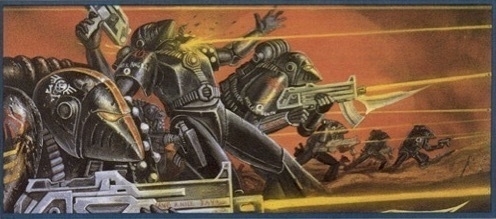
1987’s Rogue Trader has only a little background information about the discrete Space Marine chapters. Page 12 has several examples of Dark Angels wearing all black with a red stripe down their helmet.
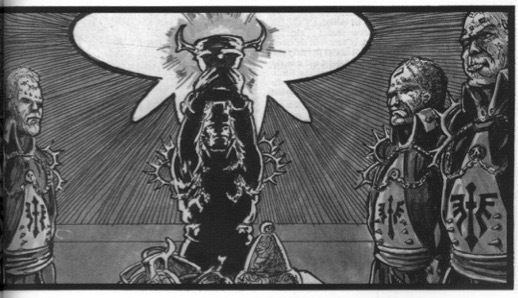
Page 138 describes the Feast of the Malediction:
The celebration of the Feast of Malediction by the Dark Angels Chapter of Space Marines. This great annual event takes place in the Seclusiam of the Dark Angels’ space fortress which orbits the giant planet Delahon. The feast celebrates the founding of the Chapter by Lynn Elgonsen at the beginning of the Imperial Crusades almost ten thousand years ago. The Dark Angels are honoured as the first Marine Chapter. They were founded by the Emperor at a time when he still lived in the conventional sense. Within the Chapter the title of the Dark Angels’ leader is Custodian, an honour which acknowledges the Emperor as the Chapter’s true leader. The Cup of Retribution used in the ritual is said to be the actual vessel from which the Emperor drank at the original founding of the Chapter. At the culmination of the feast, the Custodian takes a small knife and cuts his thumb so that a drop of blood falls into the cup. The cup is then passed around the all the assembled fighting brethren who each add a little of their own blood. Once very warrior has contributed, the contents of the cup are mixed with wine in a number of large open barrels. The cup is then passed from warrior to warrior, each filling it and drinking from the wine in turn. This ancient ritual is sacred to the Dark Angels and it is considered a bad omen is a long campaign or sudden battle delays the feast.
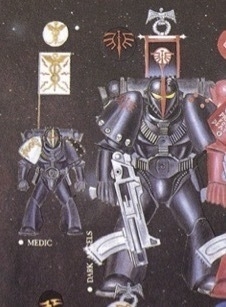
Page 156 describes Space Marine armor colors and badges. “The Dark Angels wear only black.”
White Dwarf 93 (September) announces Rogue Trader and the world of Warhammer 40,000. A two-page spread describes the dark future and the Emperor and includes a Dark Angels logo among several other chapters’. A spread showing the plastic “Imperial Space Marines” says, “There are a thousand different Space Marine Chapters including such renowned names as Spacewolves, Crimson Fists, Dark Angels and Silver Skulls.” A spread in WD 94 shows some black-colored Dark Angels miniatures.
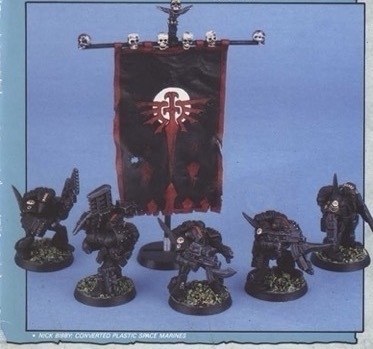
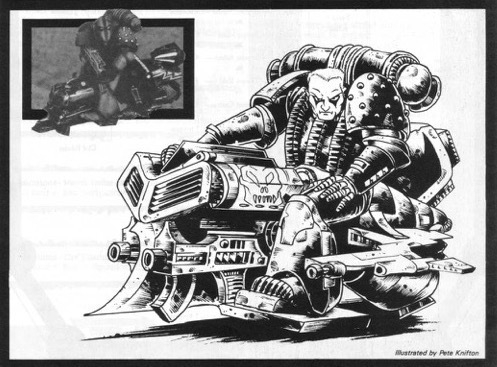
White Dwarf 96 (December) has the first “Chapter Approved” article, on the Mk14 Jet-Cycle “Bullock.” It highlights “The Raven Wing,” which at this point was the seventh company (not second) and deployed exclusively on jet-cycles:
There are ten companies (each of a hundred battle-brothers) making up the fighting brethren of the Dark Angel chapter of Space Marines. […] Number seven company is a specialised recon and attack company, known as the “Raven Wing.” Instead of the usual Dark Angel motif Brothers of the company sport a black wing overlaid by the company number on the right shoulder Armour. Equipped and trained for high-speed reconnaissance, the Raven Wing specialises in hit-and-run warfare and search-and-destroy missions.
The Primarch is named for the first time, though his name and story at this point are depicted as partially lost to history:
History. The Raven Wing’s exact origins are lost in the history of the First Crusade (circa thirtieth millennia—about ten thousand years ago). Indeed little is known about the Dark Angels during that time. The Chapter’s early history was removed from all Imperial records following the Horus Heresy and the banishment of the nine “treacher-legions” to the Eye of Terror. The reason for the erasure is now known only by the Emperor himself.
According to legend, the Chapter was founded by Lynel Jacobsen or Jonsen, a man whose reputed exploits include the incineration of Goyas Asteroid and the first sub-light circumnavigation of the Outer Dolmans. He is said to have died defending the honor of the chapter in a duel with Leman Russ (founder of the Spacewolves). This may be true, but it is more likely that the story was invented following the inter-legionary wars in the thirty second millennia. In any case, the two chapters have remained rivals at best (and outright enemies at worst) ever since.
It goes on to detail a battle over Rynns World featuring ten Raven Wing squads plus its captain and staff. The force was led by Captain Gaius Oblonsky, Lieutenant Djinn Ntonnik, Medics Kyle Kildare and Cassius Hacit, Astropaths Vedi Lazar and Rumman Koak, and Communications Mayer Rufus and Clof Bibulus. Squads were broken into two combat squads of five, led by a sergeant or the next-most senior Battle Brother. Names given are Lex, Gorz, Logos, Palchis, Albius, Habz, Tegulus, Malsh, Salireh, Kuhn, Credens, Erek, Capsus, Kanz, Eboracus, Lowg, Vincius, Dukh, Casula, and Vengt.
1988
White Dwarf 102 (June) has an “Index Astartes” feature on medics. It shows a Dark Angels medic in black but with a white torso and power pack.
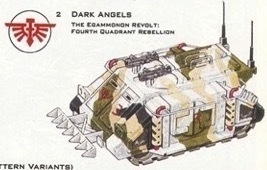
White Dwarf 103 (July) has a Dark Angels Rhino in a “Sub-Attic Tundra” camouflage pattern.
White Dwarf 105 (September) has an “Index Astartes” article which notes, as an example of “Variation from the Codex”: “A good example of organisational variation is provided by the “Raven Wing of the Dark Angels Chapter. This entire company is equipped with M14 Bullock jet cycles as appropriate to their high speed reconnaissance role.”
White Dwarf 108 (December) describes Space Marine Chaplains. It has a guide to “Typical Chaplain uniform variations,” which lists Dark Angels Chaplains as wearing skull helmets, black torsos and legs, and skull shoulder pads.
1989
White Dwarf 112 (April) shows a Dark Angels Terminator still in black armor.
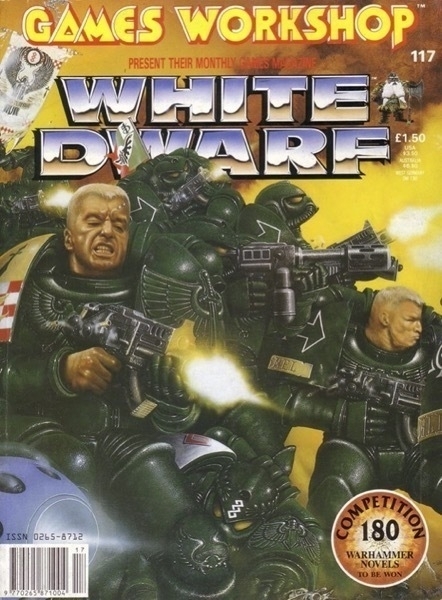
The cover for White Dwarf 117 (September) is a Jim Burns painting that was also used as the front of the Space Marine (Epic) boxed set along with metal band D-Rok’s Oblivion. The marines on the cover are definitely green, though I’ve seen other reproductions of the artwork where they’re much darker—black with a green tint rather than green. Regardless, more or less from here on, Dark Angels wear green.
The ’89 Space Marine rulebook, page 61 has a section on “Uniform Colour and Banner Chart.” It says the Dark Angels' base coat should be black with a highlight of Salamander Green.
WD 117 has a feature on Leman Russ that mentions the Dark Angels, expanding on the story from WD 96. The Dark Angels’ Primarch now has his current name:
On the world of Dulan, the Space Wolves and Dark Angels were to assault an enemy held fortress. Russ claimed the right to lead the attack, but “Lion” El’Jonson, commander of the Dark Angels, refused and started the attack early. Russ was furious, and began a feud which was to continue for three centuries. The Emperor intervened to quell the fighting, and ordered that the disagreement be settled with a duel. Leman Russ faced his friend in combat and took a blade through the heart; the duel was declared a draw, and the normally fatal wound healed within weeks.
The Primarchs were to fight four more times before the death of El’Jonson. Friends to the end, they were united by shared rivalry and sense of honour. The feud would arise again, but not in Russ’s lifetime.
White Dwarf 118 (October) has an ad for Space Marine transfer sheets for Space Wolves, Ultramarines, Blood Angels, and Dark Angels. These are now the four main chapters Games Workshop will feature going forward.
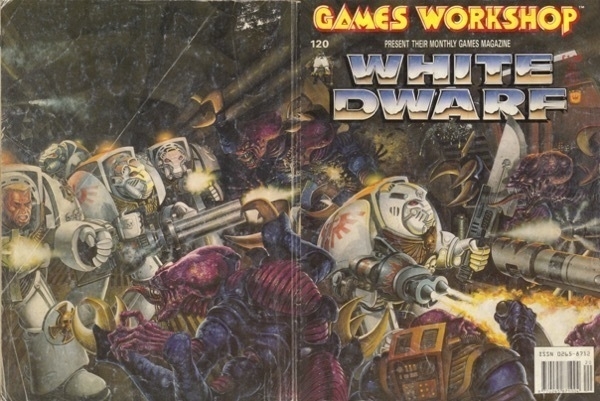
White Dwarf 119 (November) announces the “Death Wing” expansion of the Space Hulk game. №120 (December) has a Deathwing front and back cover. The Deathwing now wear pure white armor, not the more yellowed bone/cream color in current use.
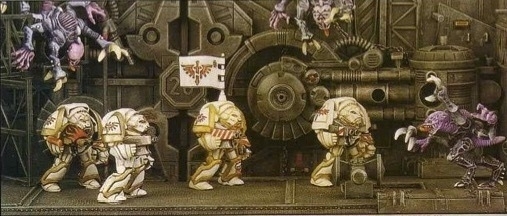
The Deathwing game also saw release of a short story by Bryan Answell and William King. It included art by Kev Walker (and maybe others) that gets featured in many WD issues over the next few months. Established in this story:
- The Dark Angels recruited from a planet called Plains World. Their culture, as explained later in WD 195, had a population that “shared many of the traits of the Native American Indians of our own planet.”
- The names of the Deathwing troopers include Two Heads Talking, Weasel-Fierce, Lame Bear, Cloud Runner, Bloody Moon, and Eagle Wing. It notes that when they joined the Dark Angels, they took on other names such as Ezekiel.
- In the story, the Terminators repaint their armor white, which represented the color of death (bones). After the mission, all Deathwing are colored white in honor of their victory over the Genestealers in the story.
1990
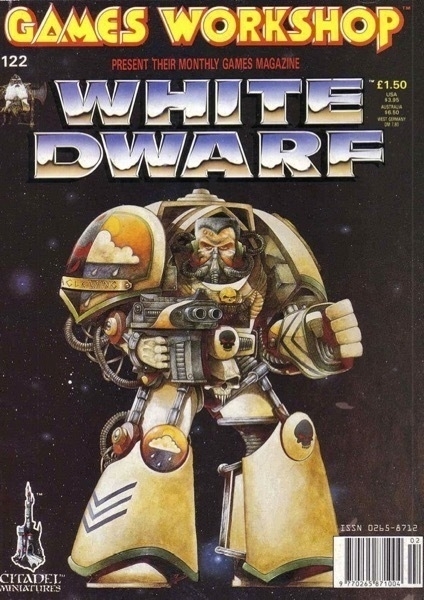
White Dwarf 122 (February) has Eagle Wing on the cover, an ad for Space Hulk and the Deathwing expansion featuring some Dark Angels Terminators (still in pure white), and some Deathwing Terminator artwork.

White Dwarf 123 (March) has the first Dark Angels miniature wearing green in an ’Eavy Metal section.
White Dwarf 126 (June), in an article on Epic Space Marines, which is set during the Horus Heresy, describes the “Regimental Organization of the Founding Chapters”:
The Dark Angels have a powerful attachment to the rituals and traditions of their homeworld. In honour of their ancestors, they apply the ancient precepts of battle to their forces: find your enemy’s weakness, test your skills against him and then make the killing blow. To this end, a Dark Angel regiment often has the three companies of the 1st Battalion dedicated to this ideal: Death Wing, Iron Wing, and Raven Wing. Sometimes the entire regiment is organized on these lines but this is rarer.
The Death Wing, Iron Wing, and Raven Wing are called the 1st, 2nd, and 3rd companies, respectively.
An ad for the Space Hulk Genestealer expansion shows an illustration of a Deathwing Chief Librarian in white but with yellow (or gold) trim. An ’Eavy Metal miniature has a Deathwing Terminator painted in this scheme: white with some yellow shading and yellow trim.
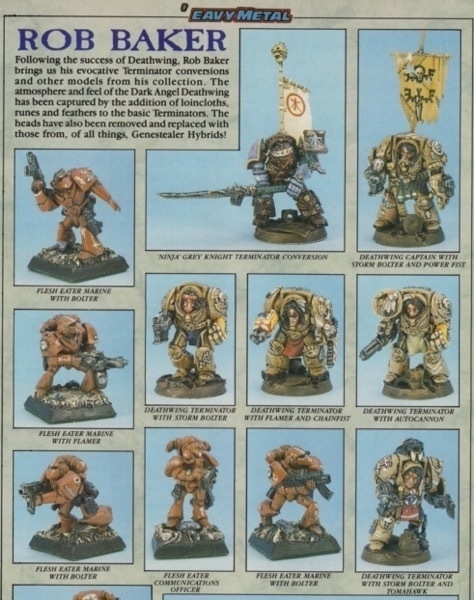
White Dwarf 127 (July) has an ’Eavy Metal spotlight on Rob Baker showing off some Deathwing conversions with lots of American Indian influence. For the first time we see a Deathwing Terminator with feathers, which would become a key piece of their iconography. The next issue has a Terminator Librarian in the ’Eavy Metal section.
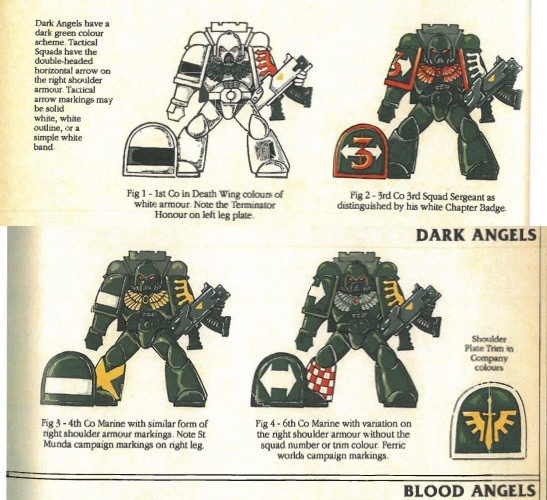
White Dwarf 129 gives us an article on Space Marine armor types and a feature on Tactical Squads. It shows Dark Angels wearing green but adhering to the Codex convention of using company colors for shoulder trim (and also chest eagles). We also see a Deathwing marine in Power Armor.
The Dark Angels are instantly recognisable by their traditional very dark green colour scheme. The chest eagle motif varies in colour depending on the company as described below. The left shoulder armour plate bears the Chapter badge in yellow with a trim in the company colours (ie same as the chest eagle). Tactical Squads are distinguished by a plain horizontal double-headed white arrow on the right shoulder. An alternative version is a simple white band alongside the rear edge of the armour: this is an especially common adaptation during long campaigns but it has become an acceptable alternative to the standard arrow either for whole squads or individual Marines. Another alternative is a double-headed arrow in outline only.
The codex dictates that the arrow bears the squad number in the company colour and that both shoulder pieces should be outlined in the same colour. However the Dark Angels do not stick as rigidly to the codex as the Ultra Marines, and many squads do not display the squad number or it may be worn only by the Sergeant. Sometimes the number is not in the company colour but is black or white instead—this is a common compromise during a campaign. Similarly the edging trim colour is often missed off the shoulder and the chests eagle may be the same colour as the armour. Sergeants are distinguished by the white Chapter insignia instead of their brother Marine’s normal yellow. Individuals companies are identified by the colour of their chest eagles, shoulder trim and Squad numbers as follows:
Chest Eagle colors. 1st Co. - dark green, but the 1st company is an exception to the normal rules as described below, 2nd - white, 3rd - red, 4th - yellow, 5 - black, 6th - grey, 7th - light green, 8th - blue, 9th - purple. As with the Ultra Marines the 10th company is considered as a reserve or training company and as such as no Tactical Squads and so is not illustrated here.
The exception to this overall scheme is the 1st Company. The 1st Company is made up of Marines who would otherwise wear Terminator armour and comprise the famous Death Wing. Just as the Death Wing traditionally wears all white armour, so the 1st Company has all white power armour. The Tactical Squad markings and other details that would normally be white are black. The chest eagle is the same green as the normal armour colour while the Chapter badge itself is red rather than yellow.
White Dwarf 130’s ’Eavy Metal pages show Deathwing in Power Armor and a Dark Angel Scout (October).
In №132 we have (December) Deathwing Terminators painted by Stuart Willis that look more like the current style—white with a wash of brown and yellow.
1991
A new version of Space Marine came out. Page 30 of the rulebook has brief background on the Space Wolves, The Dark Angels, The Ultramarines, and The Blood Angels:
The Dark Angels are age-old rivals of the Space Wolves. When they fight together each Chapter will try to outdo the other, recalling the ancient rivalry between the two original founders of these Chapters: Leman Russ Primarch of the Space Wolves, and Lion El’jonson Primarch of the Dark Angels. On eleven occasions in their history the two Chapters have gone to war against each other, the most recent being the Magdelon War in which the Space Wolves finally ousted the Dark Angels from the second moon of Magdelon and its famed gem mines. The Dark Angels uniform is very dark green and their badge is the winged dagger.
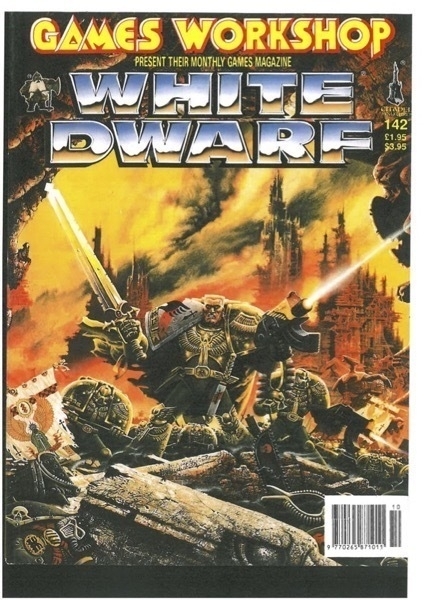
White Dwarf 142 (October) has Dark Angels on the cover, painted by Geoff Taylor. In a painting guide article for the Space Marine game we get the first mention (I think) of the Ravenwing being black. At this point the guidance still has the Dark Angels using different colors for each company like a regular Codex chapter:
- Deathwing: Skull White
- Ravenwing: Chaos Black
- Battle: Goblin Green
- Battle: Hobgoblin Orange
- Battle: Blodo Red
- Tactical: Enchanted Blue
- Tactical: Worm Purple or Grey
- Assault: Moody Blue
- Devastator: Sunburst Yellow
- Scouts: Salamander Green
The Dark Angels are slightly different to the other two Chapters described above [Ultramarines, Blood Angels] in that they have a slightly different mix of company types: one less Battle Company and a new type of company called the Ravenwing. This is a mobile mounted company riding fast vehicles, bikes and speeders. The basic uniform colour of the Dark Angels is Salamander Green, a rich dark green colour, but there are two exceptions. The Deathwing is the name of the Dark Angels’ Veteran Company and wears all white armour; the Ravenwing wears all black armour.
The company colour is optionally used for the right shoulder pad, but the company banners are all black except for the Deathwing’s, which is white. Each company HQ unit’s banner has the Dark Angel’s symbol, a winged dagger, in its own company colours except that the Deathwing has a black symbol, the Ravenwing a white symbol, and the Scouts have an unwinged dagger in either white, yellow, or red. These badges are not always used—they are optional and you may prefer to miss them off as indeed the Dark Angels themselves will sometimes do in combat. Shoulder pads can also be painted with company colours if desired.
Here and elsewhere it’s mentioned often in this era that Space Marines are not consistent about their uniforms. Marines in a particular campaign might use coloring and markings that are different than others’. (This is, of course, good story cover to explain why different players’ armies look different.)
1992
White Dwarf 146 (February) has Dark Angels Scouts on the cover and a diorama of Dark Angels called The Last Stand. It depicts a Deathwing marine in Power Armor.
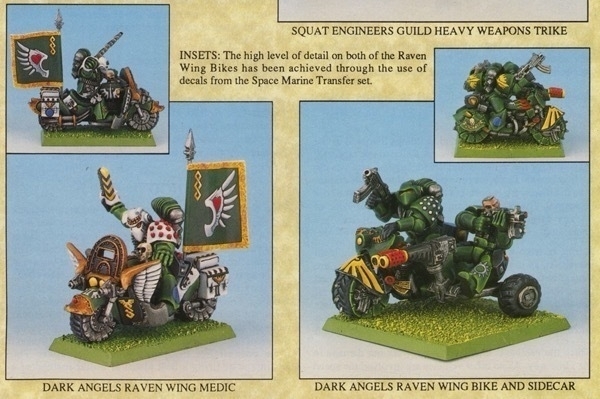
White Dwarf 149 (May) shows off Ravenwing bike models painted green. The medic flies a banner with a wing that looks very close to the current Ravenwing insignia, minus the sword/dagger in its hand.
Raven Wing Bikes: The Raven Wing is the second company of the Dark Angels Space Marine Chapter. It is completely mobile, which makes it a quick and deadly attacking force.
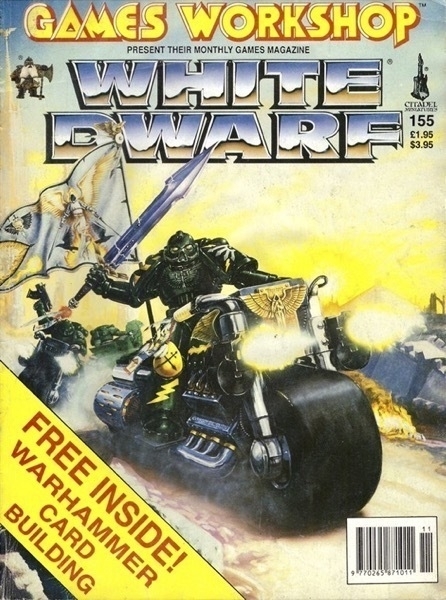
The next several issues have a few models. White Dwarf 150 (June) prints some wonderful John Blanche Dark Angels art. 152 shows a Dark Angels Captain, 155 has a cover by Dave Gallagher showing bikers in green. (From here on I’m going to skip issues that just show a Dark Angels model unless they’re notable in changing the look in some way.)
1993
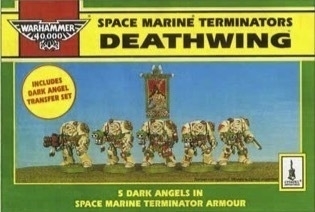
White Dwarf 161 (May) introduces the new metal Deathwing models. An article by Andy Chambers shows off new rules for using them in game and reiterates the story about why the color their armor white. It also says that the “Deathwing is particular blessed in that it has one hundred suits of Tactical Dreadnought armour, enough to equip the entire company.” The story hasn’t yet solidified around the idea that the Dark Angels’ first company only wears Terminator Armour, but it’s getting there. It also starts to build up the idea that the Dark Angels have a wealth of equipment that other chapters don’t—not every chapter can put its entire first company in Terminator Armour—they just don’t have that many suits.
Later in that issue is an article on the Horus Heresy. The Dark Angels only get a brief mention. Note the “h” in the Lion’s name:
A loyalist fleet under Leman Russ and Lion’el Johnson bearing a fresh army of Space Wolves and Dark Angels was only hours away. It would take days to break humanity’s last citadel, even with Horus leading his troops. It seemed that time had run out for the Warmaster, that his gamble had failed.
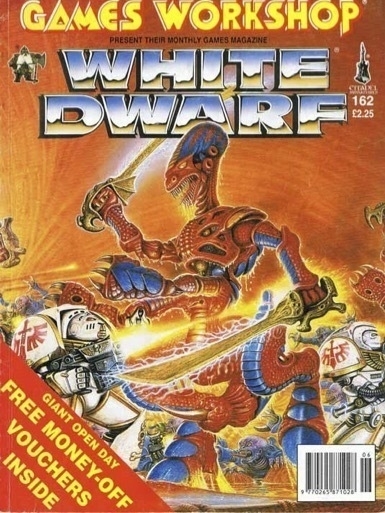
White Dwarf 162
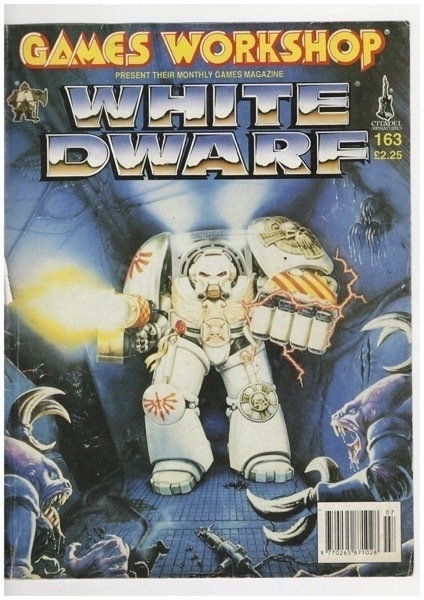
White Dwarf 163
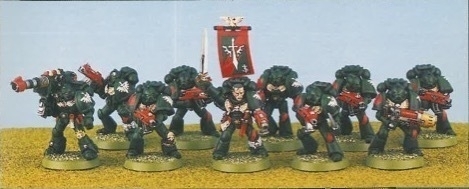
White Dwarf 166 (October) shows off the new Dark Angels Tactical Squad box, complete with a special sergeant model. Second edition is being released and the Dark Angels color scheme is now fairly fixed. Red Boltguns, no special shoulder trim, bone chest eagles.
It includes a section taken from the second edition’s Codex Imperialis book, which finally starts to establish the story of the Dark Angels:
Of the Battle Brothers of the Dark Angels history cannot speak, for there are no records of the Dark Chapter’s beginnings, of their part in the Great Crusade, or of their deeds during the terrible wars of the Horus Heresy. Only the legend persists—the legend that once the Dark Angels teetered upon the brink of Chaos, that foul betrayal besmirched the Chapter’s valour and made vain all acts of former virtue. Yet they returned to the fold of the Emperor’s love and tore themselves from the very bosom of temptation. Perhaps they sought the Emperor’s pardon too late, for ever since they have borne the Mark of the Unforgiven. Can ten thousand years of purgatory absolve those to whom every battle is redemption? Can it be the lost souls of the slain that clamour for the absolution that victory brings?
The next few dozen issues feature Dark Angels models here and there but no major story changes. The Dark Angels get a Dreadnought with Missile Launcher and Assault Cannon and a Predator kit (which is just a regular Autocannon loadout).
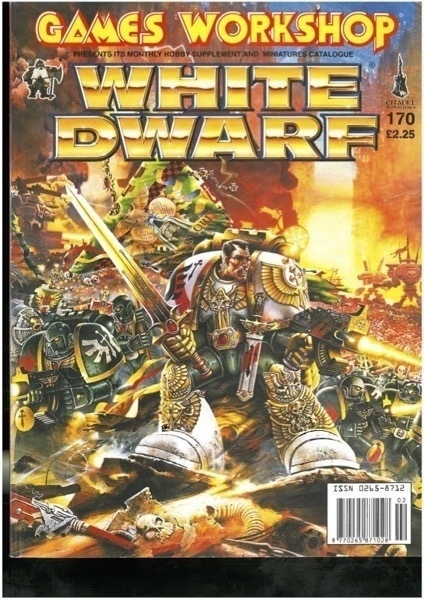
White Dwarf 170
1996
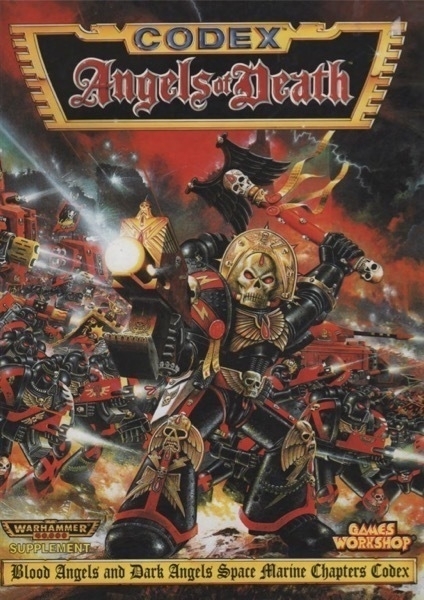
January ’96 sees the release of Codex: Angels of Death, announced in White Dwarf 193, one hundred issues after Rogue Trader’s preview in №93, along with new robed Dark Angels characters. A feature by Jervis Johnson, “Dark Saviors,” talks about new characters Azrael, Ezekiel, and Asmodai. The following issue shows standard bearer Brother Bethor.
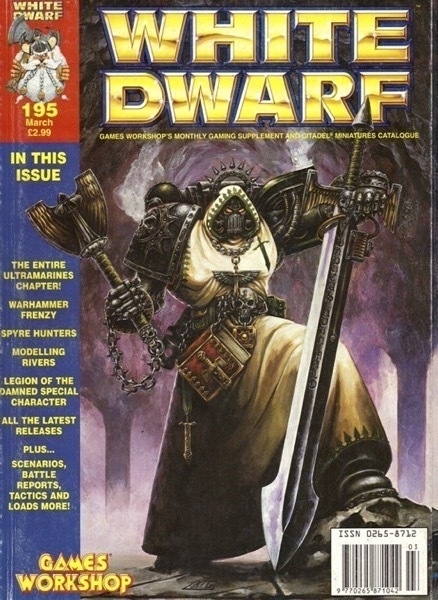
Codex: Angels of Death establishes the story of the Dark Angels, including the hunt for the Fallen, the aesthetic of characters wearing robes, and so on. The next several issues of White Dwarf show off the new miniature line of characters, including a new Ravenwing Land Speeder and a new set of bikes, now all painted black.
What did I learn from all of this (aside from that if you know where to look, you can find PDFs of old White Dwarf issues and rulebooks)? I had thought that the general storyline of the chapter—the hunt for the Fallen—had been in place longer, or had developed over time. In actuality, it was written more or less entirely by Rick Priestley and Jervis Johnson for the second edition codex. Clearly some tidbits germinated before that, starting with the short bit in Codex Imperialis, but I wasn’t able to find anything else about it, aside from a mention of their early records being stricken, prior to then. I do find it fascinating how in addition to crafting this new Unforgiven story, they brought in elements from the previous ten years. The use of a mounted company in the Ravenwing, the idea of a mobile HQ rather than a home planet, the feud between the Lion and the Wolf, and Deathwing Terminators were all brought together and made into one cohesive story. There’s even a little retcon, mentioned in passing about the Angels of Absolution’s armor color, explaining the chapter’s color change to green from black. Extra special credit goes to the way that the story of the Deathwing on Plains World finding their planet had been corrupted by Genestealers is turned into story that’s told to young Dark Angels recruits as a metaphor for the need for constant vigilance against corrupting influence with an eye toward preparing them to hear the story of the Fallen. Great stuff.
Also reading those earlier White Dwarf issues just reaffirmed to me how much personality the original “beakie” models had. I get that the new Primaris models have a better scale to them and look more fearsome, but the old figures were just so expressive!
More in this series:
- Shoulder Pads of the Dark Angels
- Dark Angels Apothecaries
- Why the Dark Angels Really Changed from Black to Green?
- How the Dark Angels story developed, from Rogue Trader to 2nd edition
- Successor Chapters
- My 4th company, “The Feared”
- The Deathwing: History and Complement
- Dark Angels Decals: A Look at Waterslide Transfer Sheets
- The Ravenwing, the Dark Angels' Cavalry
- Dark Angels Painting “Mistakes”
-
Why the Dark Angels Really Changed from Black to Green?
Continuing my series on the Dark Angels from Warhammer 40,000 (one, two), I wanted to write about the interesting ways that Games Workshop has changed the story to fit the artwork over the years.
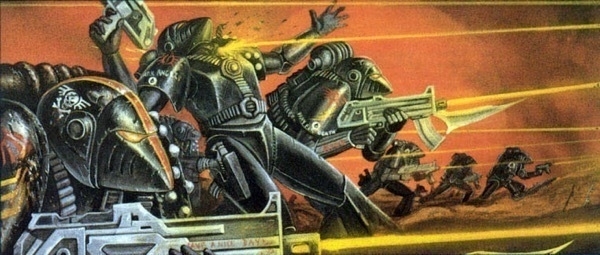
In early, Rogue Trader-era art, the Dark Angels wore black with red accents.
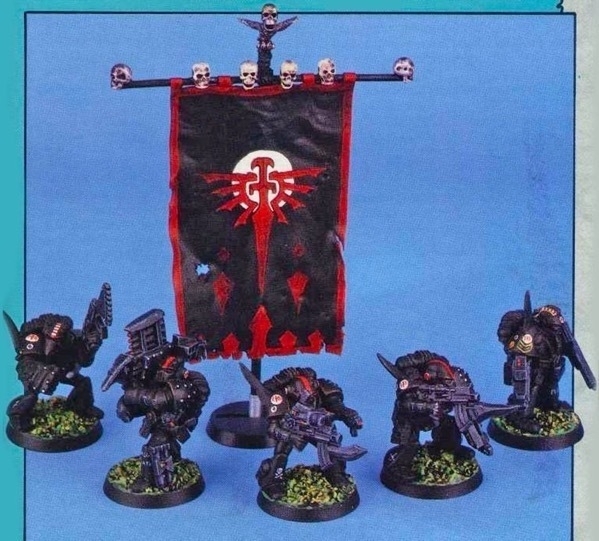
According to this great thread on the topic, the cover of White Dwarf 117 featured a painting of Dark Angels Space Marines that seems to show them wearing green. Bolter and Chainsword member Brother dean:
It is a correct depiction of how shiny black armor will reflect a yellow sky. The story that I’ve always heard is that a ’Eavy Metal painters saw the painting and made them black green.
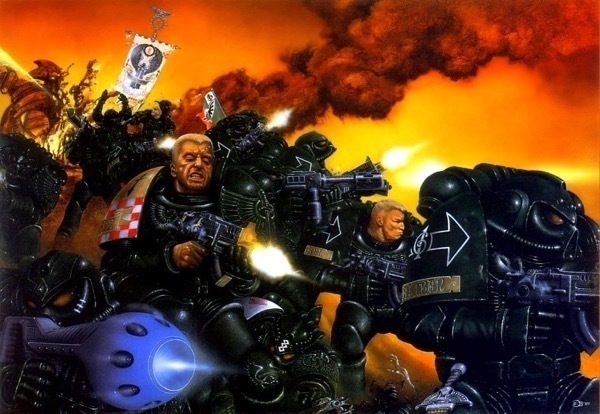
Here’s the cover itself:
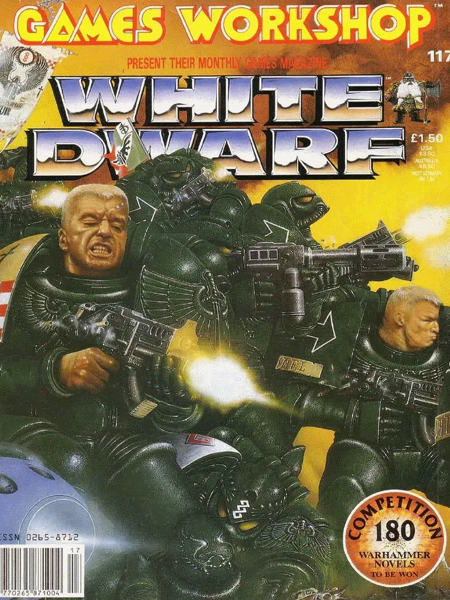
So the army had been painted black until this art came out which showed them with a green cast. The studio painters saw it and from then on started painting the Dark Angels in green. Was this an actual mistake—the ’Eavy Metal team thinking the shiny black armor was supposed to be black—or just a change because they liked the green scheme? Either way, within the year the Dark Angels got new outfits.
At the same time the Deathwing expansion of Space Hulk came out featuring Dark Angels Terminators wearing bone white armor. This resulted in two eventual changes to the lore. First, the idea was introduced that black color scheme was what the original legion wore. There’s one mention of it that I can find in the 2nd edition codex, which refers to the Angels of Absolution having “retained the traditional black armour of the original Dark Angels Legion.” Later stories would say that after the Heresy and the destruction of Caliban, the chapter repainted their armor in honor of the green forests of their homeworld.
Meanwhile, a similar story was written to explain why the Terminators now wear bone white armor instead of black, which was that a squad of Deathwing Terminators returned to their homeworld to look for new recruits but found it “in the grip of a Genestealer infestation.” They repainted their armor to the color of bone, which represented death in their culture, and the Deathwing ever since has used that color in honor of their victory. (That story also featured American Indian imagery—the world was called Plains World, the characters had names like Cloud Runner and Two Heads Talking, and Dark Angels and Deathwing models started featuring feathers as decorations. Over time GW would walk back this icongraphy and wrote a story explaining that the Dark Angels recruited from many worlds, including Plains World, and that the Battle Brothers take new names upon joining the chapter, so Cloud Runner and Two Heads Talking became “Ezekiel” and “Lucian.” This allowed them to play up the Dark Angels as grumpy knights while still retaining the Indian-inspired story elements.)
Similar changes have been made elsewhere. Over time GW changed the how Space Marines' boltguns look slightly. It now sells a line of Horus Heresy-era miniatures wearing archaic armor which are designed to look like the older armor and gun designs, making the retro looks old in the senses both of the miniature range and the storyline. On a much larger scale, the game’s rules got a major overhaul in 8th edition, but the Horus Heresy game, set 10,000 years before the setting of the regular game, retains many parts of the previous rules system. In essence, and entire ruleset was retconned. It’s similar to how DC Comics would alter its storyline or move entire characters to an alternate Earth to explain differences between old issues and newer plots. GW could have just made these changes without explanation, but it’s much more fun to write them into the story.
(One last example I really like: A recent storyline involved the creation of a whole bunch of new “Primaris” Space Marines. A large number of these were not assigned to any particular chapter but instead served as reserve forces for a large campaign. On their shoulder they wore a grey chevron symbol, from which they got the nick name “Greyshields.” This grey is intended to be the same color as unpainted plastic models. They’re Space Marines who are fresh out of the box.)
Hobby-wise, It might be interesting to try painting a Heresy-era or Fallen force with shiny black armor. I have a Cypher model waiting for paint. I may try a base coat of Leadbelcher and then using a thinned-down Black Templar over it, maybe with some ’Ardcoat to finish it.
More in this series:
- Shoulder Pads of the Dark Angels
- Dark Angels Apothecaries
- Why the Dark Angels Really Changed from Black to Green?
- How the Dark Angels story developed, from Rogue Trader to 2nd edition
- Successor Chapters
- My 4th company, “The Feared”
- The Deathwing: History and Complement
- Dark Angels Decals: A Look at Waterslide Transfer Sheets
- The Ravenwing, the Dark Angels' Cavalry
- Dark Angels Painting “Mistakes”
-
Wonder Woman Doesn't Say Hello
In the third issue of Final Crisis (2008) by Grant Morrison and JG Jones, Wonder Woman, fighting Mary Marvel, exclaims “Hola!”
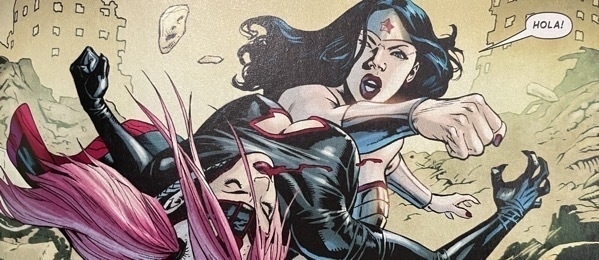
Morrison uses it again in last week’s Wonder Woman Earth One vol. 3:
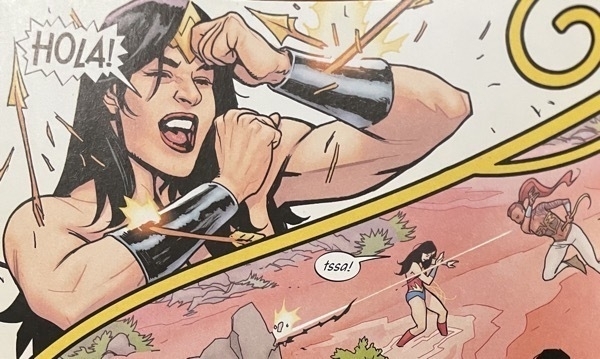
To my American eyes, it looks very much like Wonder Woman really likes to say “hello” to people she’s fighting. In actuality, she’s using a battlecry first seen (I think) in Wonder Woman 1. (She appeared prior to that in All Star Comics 8 and Sensation Comics. WW shows an expanded version of her ASC origin.)
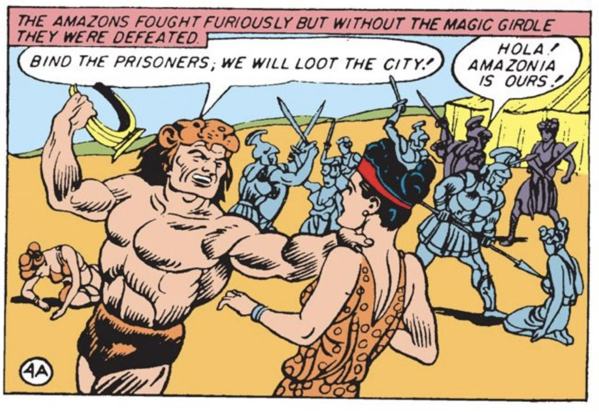
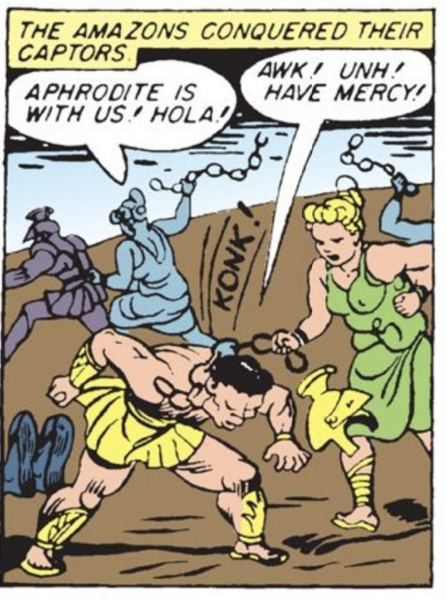
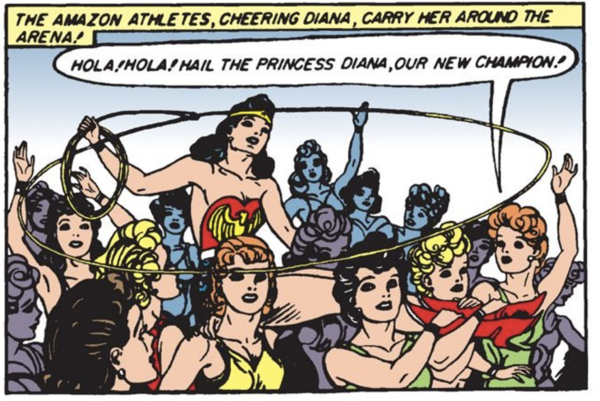
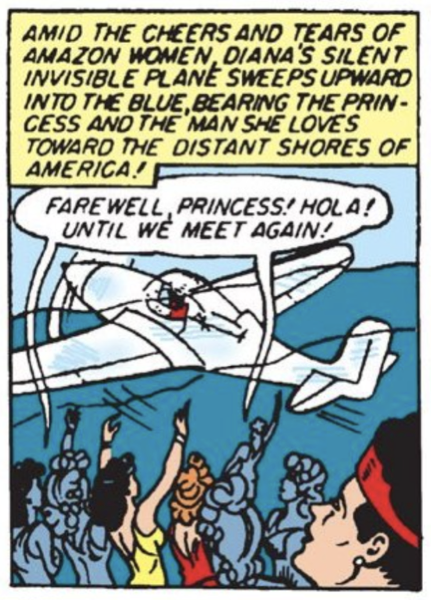
Okay, so if Wonder Woman used this battlecry in her early appearances, then where did author William Moulton Marston get it from? Turns out this is incredibly hard to find on search engines. “Amazon” is an internet company, “hola” is a common Spanish word, and Wonder Woman has a recent movie out, all of which gunk up the results. The best I’ve been able to find—my guess for the moment—is the Ancient Greek battlecry “alala,” which relates to a goddess, niece of Ares, who personified war. Maybe it got transliterated to “hola” at some point and Marston picked it up from there?
I’d love to hear other theories as to why the Amazons in DC Comics use this particular exclamation.
-
Dark Angels Apothecaries
As a follow-up to my previous piece about the Dark Angels, I wanted to take a look at how Apothecaries should be painted. The question: should they be all white, or wear their normal color with white embellishments? (TL:DR: White, in my opinion, but sources differ.)
The basic guidance, as I understood things, was that each Space Marine chapter has its own colors—blue for Ultramaines, red for Blood Angels, and so on—but that Techmarines, Chaplains, Librarians, and Apothecaries wore their own colors of office—red, black, blue, and white, respectively—instead, with just the left shoulder pad showing their chapter’s colors. For medics, especially, it makes sense to have them be easily identifiable. In present day (though this would certainly be laughable in the grim, dark future of the 41st millennium) medical staff are not supposed to be treated as targets.
Here, though, is a Rogue Trader-era photo which shows a good bit of variation.
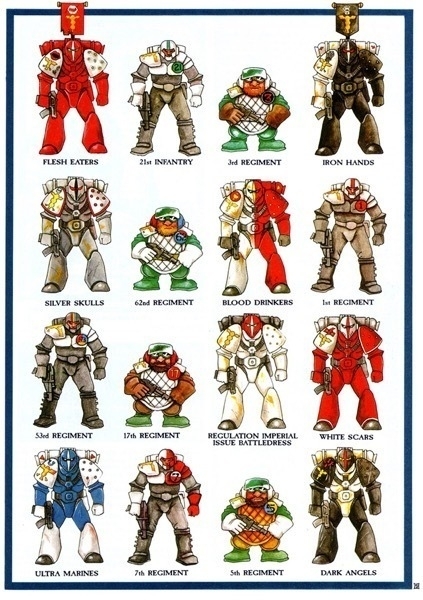
Note the Dark Angels example, bottom-right, in what’s now considered to be their pre-heresy color scheme along with a Consecrators-like stripe on his helmet.
By the second edition of Warhammer 40,000 they were wearing all white.
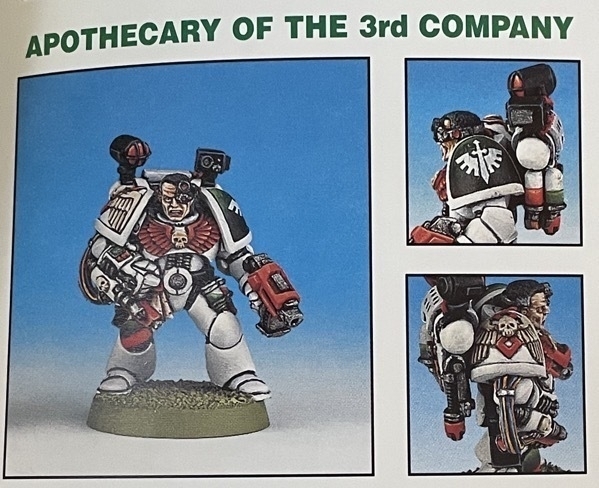
Second edition codex
His left shoulder pad is green and shows the Dark Angels symbol but could otherwise be an Apothecary for any chapter. (He’s also wearing his 3rd company designation on the wrong knee. How embarassing!)
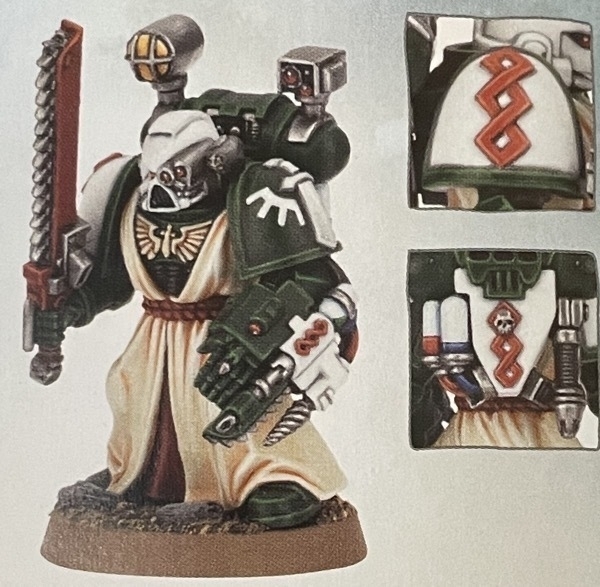
The sixth edition codex makes a change. We have a robed Apothecary wearing green with a white helmet, right shoulder, and narthecium.
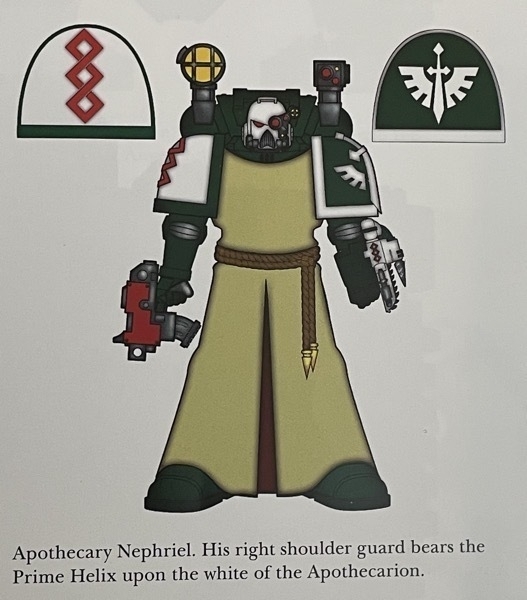
Sixth edition codex
Seventh edition codex
Deathwing Apothecaries are shown in bone with white accents.
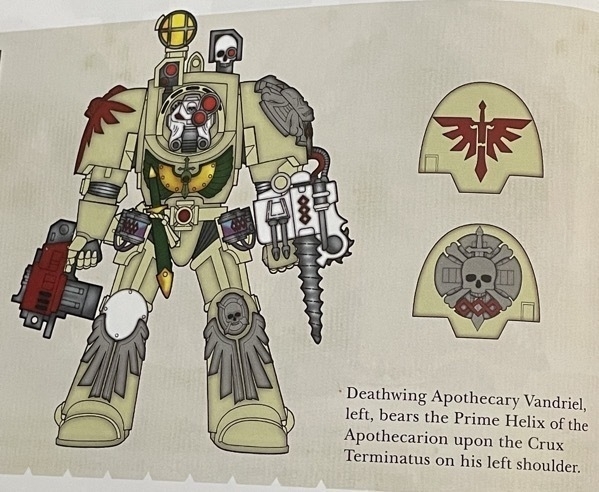
Sixth edition codex
In eighth edition, however, we get an illustration of a Primaris Apothecary in white.
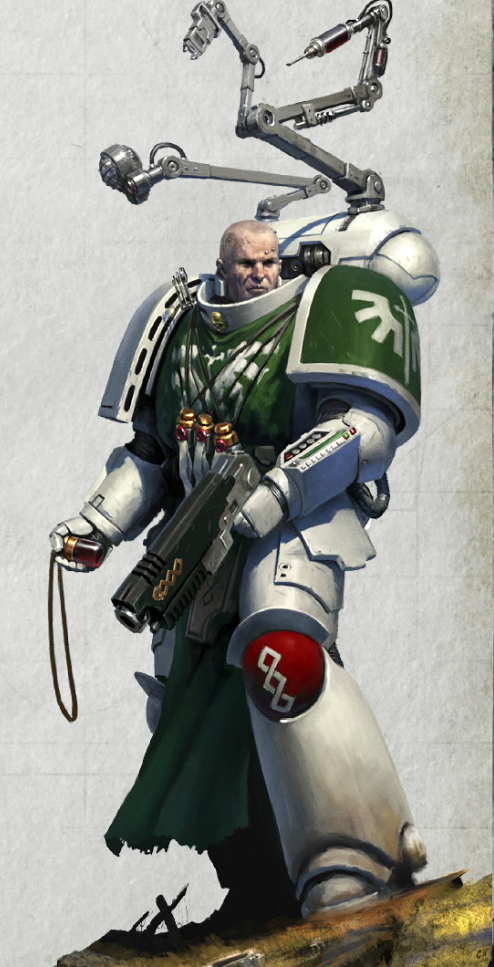
Eighth edition codex
Black sidearm, though, rather than red. This is another detail that’s changed over time. 3rd edition-era Dark Angels carried black guns, but that didn’t last. They’ve been shown red more often than not. Also note that his kneepad has a helix, not a company badge. Each company does have its own Apothecary, so either this is an error or this is how they show they’re not attached to a particular company.
Ravenwing Apothecaries have always been depicted in all white.
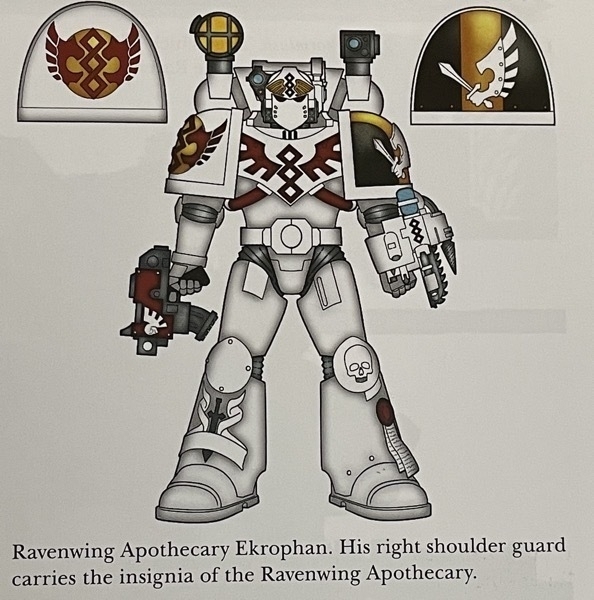
So which is it: white or green (or bone or black)?
The real answer, as always, is that they’re your models and you can paint them however you want. Here we have a case where the official books even give you both options. I’ll argue for white, though. The Blood Angels' Sanguinary Priests tend to wear a lot of red, but they have an in-story reason for differing from the codex: they partially serve as company spiritual figures since the Blood Angels' Chaplains are devoted to babysitting their battle brothers who have fallen to the black rage. Iron Hands don’t paint their Techmarines red which implies they’re not kept at as much of a distance. Dark Angels don’t give any special role to their Apothecaries—they’re not even Inner Circle.
So why is the Deathwing apothecary in bone? (He actually is Inner Circle since he works with the Deathwing day-to-day and it would be rude for them to have to shut up whenever he entered the room.) I suppose there’s an argument that his Deathwing-ness overrides his medic-ness, but I think it’s just what the studio painter happened to decide. Maybe they thought it looked strange to have one model wearing a different color than the rest of his squad. Him wearing his company colors would match the green Apothecary of the era (though not the white Ravenwing one).
I’d like to construct an argument that the 8th edition Primaris Apothecary in all-white represents a decision by Games Workshop to roll back the variant for the Dark Angels, but really that’s wishful thinking on my part. It’s probably actually the case that the artist just painted him white, and I’ve not seen an official studio model of a Primaris Apothecary in Dark Angels green. Early promo art for the Dark Angels Combat patrol showed they didn’t even have a Primaris Chaplain model—his shoulder pad is clearly from an Ultramarines collection—and it differs from the color scheme seen in the codex which has him in a green robe. All of which to say, not all of Games Workshop treats this stuff as rigorously as I’d like.
I’ll leave the last word to the fourth edition of Codex: Dark Angels:
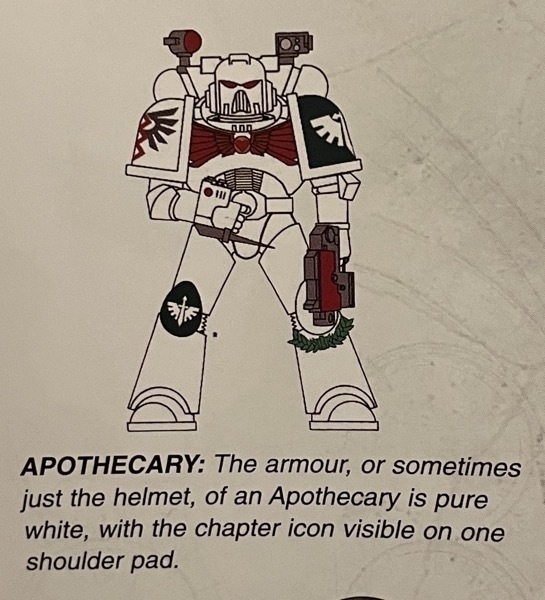
“The armour, or sometimes just the helmet, of an Apothecary is pure white, with the chapter icon visible on one shoulder pad.”
More in this series:
- Shoulder Pads of the Dark Angels
- Dark Angels Apothecaries
- Why the Dark Angels Really Changed from Black to Green?
- How the Dark Angels story developed, from Rogue Trader to 2nd edition
- Successor Chapters
- My 4th company, “The Feared”
- The Deathwing: History and Complement
- Dark Angels Decals: A Look at Waterslide Transfer Sheets
- The Ravenwing, the Dark Angels' Cavalry
- Dark Angels Painting “Mistakes”
-
Shoulder Pads of the Dark Angels
Of all the things I have opinions and knowledge about, surely some of the least important must be the proper way to mark squads of Dark Angels Space Marines from the tabletop wargame/hobby Warhammer 40,000. When I started playing the game in 1996 or so, this stuff wasn’t so complicated. The 2nd edition codex had two full pages on how to mark your squads! But now, with dozens of different unit types in the game, I see a bit of confusion about this online, so I hope this guide will be useful to anyone who’s curious about this stuff.
A few notes before I begin. First, feel free to ignore all of this and paint your army however you want! They’re your models, after all. Second, it’s common for a Space Marine chapter while on a long crusade to change up its markings as needed, combine companies together as they take casualties, adapt their squad types for missions, etc. Third, while the books say the Dark Angels generally follow the Codex Astartes aside from the first and second companies, they also like to be a bit mysterious and do stuff to suit their own purposes. In particular, it’s rumored that Azrael keeps the roster at well over 1000, which would have implications on a lot of the squad numbering I mention below. All of which to say, there are lots of reasons to deviate from any of this stuff.
Also, when I talk about left/right shoulder/kneepad, I’m always referring to the model’s left or right.
Choosing Your Company
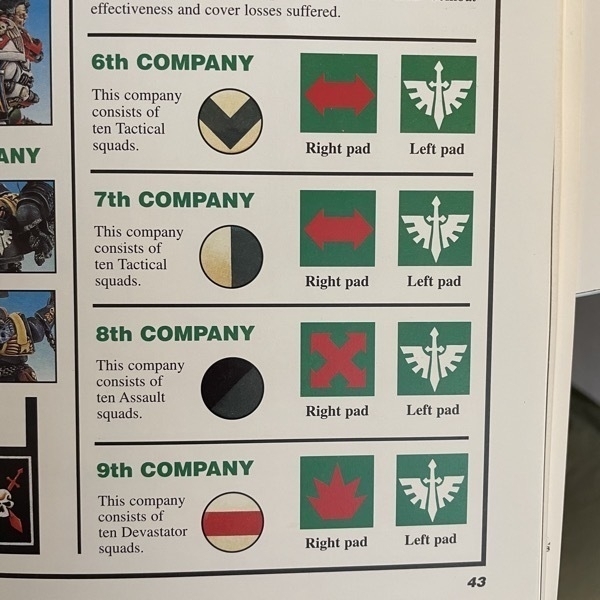
Space Marine Chapters are organized into companies of 100 battle brothers each. Most chapters have a veteran company, battle companies, reserve companies (6th–9th), and a scout company (10th). The Dark Angels differ slightly in having two veteran companies (1 & 2) at the expense of one fewer battle company.
All of your “greenwing” marines belong to either a battle company (2–5) or a reserve company (6–9). It doesn’t matter which company you choose. The left kneepad of every member of that company will display its symbol, which can be seen here. The 3rd is the easiest to paint. If you intend to run Lazarus and not a generic Company Master, you should consider painting them as the 5th, or you can make up a story for why Lazarus is leading a different company, or why someone else is leading his—maybe he’s on vacation. (Dark Angels vacations are solemn affairs with lots of incense.)
Most marines will have their company marking on their left kneepad. There are some exceptions:
- Deathwing and Ravenwing units don’t put anything special on their knees. Their armor color tells you what company they’re in.
- The Scout company doesn’t have a knee marking. Note that in addition to scouts, the 10th company has a full complement of Vanguard squads (Infiltrators, Incursors, Reivers, Eliminators, Suppressors, Invictor Warsuits), so an Infiltrator squad, for example, might be from any of companies 3–7, or 10. (But not 8 or 9 because they’re all close support and fire support squads, respectively).
- Each company has 1 chaplain and 1 apothecary in addition to its other command squad units, but there are chaplains and apothecaries that are not part of a company, so you can decide if yours is attached to that company or unassigned and paint his kneepad accordingly. Interrogator-Chaplains, Techmarines, and Librarians are not typically of a particular company. Even if they’re wearing Terminator Armour, they’re still not part of the 1st Company and so should also have green shoulder pads. (Asmodai or Ezekiel signs their checks and approves their overtime, not Belial. Codex: Dark Angels (2015) shows an Interrogator-Chaplain in Terminator Armour with a green shoulder pad on p61. But, again, paint your army however you want.)
The battle companies, 3–5, have 60 Battleline marines, 20 close support, and 20 fire support. More on that below. If you go over any of these limits, you can paint the extras as from a reserve company on their left kneepads. Companies 3, 4, and 5, thus, look like this:
- Squads 1–6: Six squads of ten battleline marines
- Squads 7–8: Two squads of ten close support marines
- Squads 9–10: Two squads of ten fire support marines
The reserve companies, 6–9, are a little different. Six and seven are all battleline units. Eight is all close support units. Nine is all fire support units. These are used to supplement additional companies that might need more squads of a certain type than the codex allows.
Color Schemes
The Citadel Colour app will give you a good guide on what paints to use. A few general guidelines (that you’re free to ignore, of course):
- Dark Angels don’t change their helmet colors; they always match their armor.
- Shoulder trim also always matches the armor, with exceptions for some officers/special characters.
- The chest device (aquila) is always bone white for greenwing and Ravenwing (not gold) and green for Deathwing (unless he’s wearing a green robe, in which case it can be red). This allows the greenwing to be green/bone which complements nicely with the Deathwing’s bone/green.
- Dark Angels chapter symbols are cool white, not bone white. (Ravenwing, too.)
- Boltguns are red, typically, but can be black. The grip of the boltgun is black.
- Generally only officers wear robes, though sergeants might. Rank and file battle brothers are often in standard power armor without even tabards. The basic idea is that a younger marine mostly looks just like any other standard marine in any chapter, and the closer they get into the inner circle, the more they cover up.
- Winged helmets tend to be reserved for masters and company champions.
Unit Types
Below, I’ll go over the major unit types and what goes on the shoulders. Many other Space Marine chapters assign a special helmet color to sergeants and officers, and use their shoulder trim to designate company colors. In general Dark Angels don’t do this.
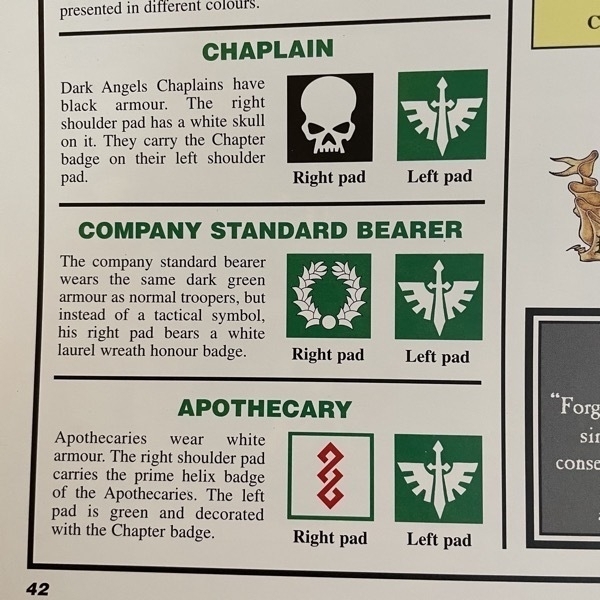 *Character markings, 2nd Edition* Codex: Angels of Death.
HQ
Captains (Masters) typically have an imperial eagle on their right shoulder, Dark Angels symbol on their left. The right might be an angel, though (as seen on the Lazarus kit, for example), or some personal heraldry (Sammael). The captain of companies 3–9 will have his company’s heraldic symbol on his left kneepad or maybe on a tilting plate or elsewhere. One Master per company.
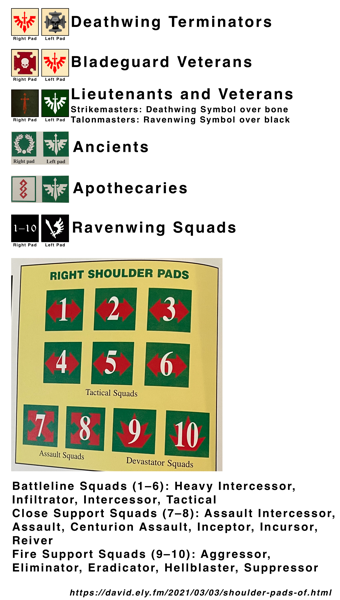
Lieutenants should have a red sword on their right shoulder, the appropriate Dark Angels symbol on their left shoulder. This includes the Strikemaster and the Talonmaster (though neither unit has rules in 10th edition). Your company should have at most two Lts (though potentially one guy could have a set of Mk X eveningwear and a Phobos suit to wear for daytime fighting). (Source here is little bit shaky. The Dark Imperium box included two Lieutenants and its transfer sheet had two red swords. The GW studio Dark Angels Primaris Lt model has a red sword on his shoulder.) A mark of personal heraldry would be an acceptable alternative.
Chaplains have a skull on their right shoulder (over a black field generally but it’s fine to paint it green) and a Dark Angels symbol on their left.
While chaplains are organized under the Reclusium, each company has one chaplain assigned to it who oversees the spiritual needs of its battle brothers. Indeed, a chaplain has been listed as part of its company since Codex: Angels of Death (1996) (p36). Games Workshop’s studio model of the Ravenwing Chaplain has his right shoulder pad black with a Ravenwing badge, so it’s reasonable to deduce that if a chaplain is assigned to a company, he wear his company’s colors (though an unassigned chaplain would wear green).
So, if it’s a Chaplain in Terminator Armour, he’s the 1st Company’s Chaplain, and his right shoulder can be bone white with a red Deathwing symbol and his left should have a Crux Terminatus. If it’s a Chaplain on Bike, his right shoulder should be black with a white Ravenwing symbol and his left would be black with a skull symbol.
The chapter also has chaplains that aren’t assigned to a particular company. They’d have a normal Dark Angels chapter badge on their left shoulder over green.
(I will note that only some editions of Codex: Dark Angels explicitly show a chaplain in the 1st company’s complement. Whether this is an oversight or an intentional declaration that the 1st company doesn’t have its own chaplain is up to you. In my mind, a company chaplain has a specific role in guiding and advising his battle brothers. I don’t know why the 1st company wouldn’t have a place for this. An Interrogator-Chaplain has a different job entirely.)
Librarians have a horned skull on their right shoulder (over a blue field) and a Dark Angels symbol on their left. If he’s wearing Terminator Armour, it’s a green right shoulder with a DA symbol and a crux on the left.
Apothecaries have a helix on their right, DA symbol on left, and their company’s symbol on their right kneepad. Here’s a piece I did on apothecary armor colors.
Techmarines have a cog on their right shoulder, DA symbol on the left. Tip: There’s a DA-specific cog and head on the Ravenwing accessory sprue.
Elites
Ancients should have a laurel wreath on their right shoulder, DA symbol on their left. There’s a pad for this in the old Company Veterans box.
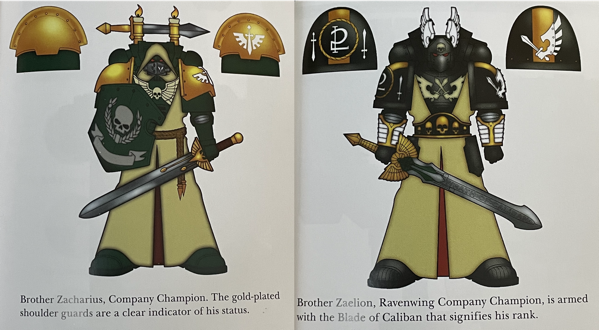 Codex: Dark Angels, *six edition*
Company Champions have a special shoulder pad that used to come in some of the command squad boxes. There isn’t a clear symbol or badge for the position.
There’s no consistent guidance on what a Champion should have. Some of GW’s studio models have a wreath, but DA definitely use that symbol for their Ancients. This piece shows a laurel wreath surrounding a skull. 🤷🏻♂️ I painted the 4th company’s checkerboard device on the right shoulder of mine.
(Non-Deathwing) Veterans in previous editions were marked with a red sword. Now that the Lieutenant has taken over this symbol, there hasn’t been updated guidance on how to mark up a veteran. My recommendation would be a white or silver sword, which is supported by the Company Veterans box art, but red is fine. This is sort of moot because there’s not a big reason to take Company Veterans or Veteran Intercessors, but this is still unresolved. Also, various editions of the codex differ on whether it should point up or down.
Bladeguard Veterans, Sternguard Veterans, and Vangaurd Veterans should have a Crux Terminatus on their right shoulder and a Deathwing logo on their left shoulder. There are crux transfers on the Indomitus and Leviathan sheets. Yes, they are Deathwing, which is a lore change from previous editions when Deathwing always only wore Terminator Armour. More on that here.
Deathwing Terminators should have a Deathwing symbol on their right shoulders, Crux Terminatus on their left.
Deathwing Knights have fancy Dark Angels on their right shoulders, Crux Terminatus on their left, and elsewhere (knee, tilting plate, wherever), a squad-specific pattern, typically a Quartering in some combination of red, green, bone, black, or white. Both shoulders can have a thin green line tracing the borders.
Black Knights have gold pale over black on their shoulders. The right shoulder has a squad number, the left is a Ravenwing symbol. (“Fun” fact: Each Space Marine company has a traditional heraldic pattern and color. A gold pale is the 2nd company’s in many chapters. Dark Angels follow these loosely. You can see more examples here.)
Squads
Sergeants are not picked out in a conspicuous way as in other chapters that change the helmet color or add a stripe. A general Space Marine convention, though, is that sergeants have skulls on their helmets. You can also use the sword helmet from the upgrade sprues, or model your squads so that the sgt doesn’t have a helmet on to make him more obvious. For firstborn squads, the robed figures from the honor guard set make great sergeants.
Deathwing Terminator Squads
Deathwing squads aren’t explicitly numbered. Remember that their chapter badge goes on their right shoulder, the Crux Terminators on the left.
Ravenwing Squads
The Ravenwing is organized in a way that matches a previous edition’s concept of formations. There are two types of Ravenwing squads.
Attack Squads should have a gothic 1–5 on their right shoulder and a Ravenwing symbol on their left. They are composed of ten marines: six bikers, 1 attack bike, 1 Land Speeder (or Typhoon or Tornado variant). In the fluff these squads would be training and hunting together. All 10 marines would have the same number on their shoulder.
Squads 6–10 are Support Squads. They’ll consist of a squad of attack bikes or land speeders and a Land Speeder Vengeance or a Darkshroud.
Unresolved is how to mark up squads of Primaris Ravenwing marines, but I’ll make an argument for 1–2 Outrider squads, 1 ATV, 1 Storm Speeder for Attack Squads, and squads of ATVs in Support Squads with a Storm Speeder and/or the other heavy speeder types.
Nephilim Jetfighters and Dark Talons are flown by Ravenwing pilots, not Techmarines. if you want to put a decal on their right shoulder, squads 2 and 3 typically supply the pilots.
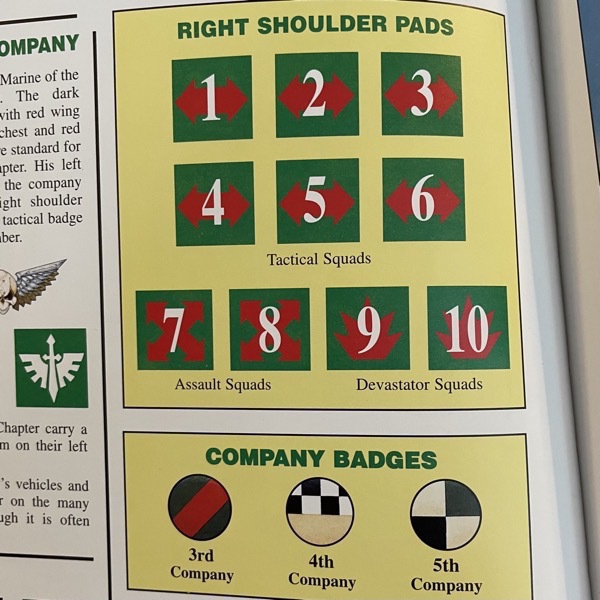 *Battle company squad markings*
Battleline Squads
Page 16 of the 9th edition Codex: Space Marines breaks down squads into three types. These squads are part of the battleline:
- Tactical Squads
- Intercessor Squads
- Infiltrator Squads
- Heavy Intercessor Squads
They should have a two-headed arrow on their right shoulder pads, a Dark Angels symbol on their left. Superimposed over the arrow should be the squad number, which should be 1–6. If you have more than 60 (!) of these, you should mark the extras as being from the 6th or 7th reserve company on their left kneepads. (The 6th and 7th would have squads running up to 10.)
 *Reserve companies*
Close Support Squads
These squads should have a four-headed arrow on their right shoulder, a Dark Angels symbol on their left:
- Assault Intercessor Squads
- Assault Squads
- Centurion Assault Squads
- Inceptor Squads
- Incursor Squads
- Reiver Squads
Their squad number should be 7 or 8. If you have more than 20 of these marines, mark the extras as 8th company.
Fire Support Squads
These squads should have a blast symbol on their right shoulder, a Dark Angels symbol on their left:
- Aggressor Squads
- Centurion Devastator Squads
- Devastator Squads
- Eliminator Squads
- Eradicator Squads
- Hellblaster Squads
- Infernus Squads
- Suppressor Squads
- Desolation Squads
Their squad number should be 9 and 10. Reserves go in the 9th company.
Also, from page 22 of C:SM:
Even the squads themselves can be broken down to fight in a variety of roles should their captain require it. Should three brothers be detached from their fire support squad to form an Eliminator Squad, the remaining seven can form a Hellblaster Squad, pilot Invictor Warsuits, or fulfill a number of other roles.
So as with the Ravenwing having mixed squadrons, your 9th squad might be 3 Eliminators, 6 Aggressors, and an Invictor, all with a 9 on their shoulders.
Combat Squads
It’s fashionable these days to field squads of five, not ten. Two squads of five Intercessors would still all be part of, let’s say, squad 1, they’re just operating as two demi-squads. As such, all ten might have a “1” on their shoulder. One would be led by the squad’s sergeant, the other by a designated squad leader. In-game both are sergeants. Personally I give the proper sergeants an ornament on their backpacks and usually model them without a helmet, while the squad leader gets a helmet with a sword or skull on it. None of this matters in-game, it’s just a bit of flavor I try to sprinkle in.
I’ll update this guide as needed, or if I’ve gotten any of this wrong. One last note: my general feeling is that if you’re playing a pre-made army like Dark Angels, part of the fun is trying to be “correct” with all of this, but they’re your models so do whatever you think looks good! Even better, make your own custom succesor chapter and make up your own rules for how and why your chapter does what it does.
Here’s a quick infographic with some of these.
Version history:
- 3 Mar ’21: published.
- 19 Jan ’24: updated for 10e.
- 24 Jan ’24: added Infernus squads to fire support.
- 7 Feb ’24: added citations for Chaplain shoulder pad colors.
- 11 Dec ’24: added not that not all version of the codex show a 1st company chaplain.
- 24 Mar ’26: fixed some typos, added section on color scheme.
- Shoulder Pads of the Dark Angels
- Dark Angels Apothecaries
- Why the Dark Angels Really Changed from Black to Green?
- How the Dark Angels story developed, from Rogue Trader to 2nd edition
- Successor Chapters
- My 4th company, “The Feared”
- The Deathwing: History and Complement
- Dark Angels Decals: A Look at Waterslide Transfer Sheets
- The Ravenwing, the Dark Angels' Cavalry
- Dark Angels Painting “Mistakes”
-
Wallachia 2.0.3
Release notes
- iPad keyboard shortcuts: Use the “[“ and “]” keys to move back/forward a page. ⌘-T shows the Table of Contents. ⌘-W closes the Table of Contents, if open, or closes the book.
- Fixed a bug where the application badge count didn’t reset to zero after a new chapter notification is received.
- Removed the “What’s New” page since 2.0 has been out for a while.
App Privacy
The Wallachia app does not collect any information about you. It doesn’t track you. It contains no third-party code.

-
Very small application update coming to the App Store today.
In previous versions, fi you had the table of contents page open and tapped the chapter you were currently reading, the table of contents would close and take you back to the page you were reading. Now, it takes you back to the first page of the chapter. If you want to stay on your current page, the “Resume” button at the top of the screen will do that. I like this behavior better because it gives you a quick way to go back to the start of a chapter if you do want to.
Toggling the buttons when you tap the screen should be speedier now.
Changed the way notifications are handled by the system.
-
Wallachia 2.0
A new version of the Wallachia app should be in the App Store shortly. It requires iOS 14, but the previous version should keep working fine until you upgrade. 🤞🏻
Before I run down the features, I want to thank everyone who’s been reading and supporting me this past year. It’s been a ton of work but it’s been incredibly fulfilling. With this version finished, I’m looking forward to getting back to writing. (Though I’m sure there will be some bug fixes to do.)
New in 2.0, roughly in order of importance:
🎧Audiobooks have been removed from the app. This removes a lot of programming complexity for me. I don’t think a ton of people were using the audiobooks in the app, but if you subscribe to the podcast you’ll get the audio chapters the same day the prose versions go up.
📚The app now includes a library of “Essential Vampire Classics": Lord Byron’s fragment of a novel, John William Polidori’s The Vampyre, J. Sheridan Le Fanu’s Carmilla, and Bram Stoker’s Dracula. There are many more pre-Dracula stories I could include, but this will get you started.
The books are from Project Gutenberg with a lot of formatting applied. I think they look fantastic but please let me know if you run across, say, a Latin word that hasn’t been italicized or a paragraph that’s not indented.
🆕Serialized classics. Starting with Carmilla, I’ll be releasing new chapters of classic books every week (assuming I can keep that schedule). Carmilla will run for a few months, then I’ll set up a new one.
🔔Notifications can be configured per-book. If you grant access to the app, you’ll see a bell icon in the toolbar for each book. You won’t get notified for books you haven’t opened, and you can turn them off for any book you don’t want notifications for using that icon.
🔢Handy page counter. Ebook readers tend to have a way to tell you how many pages are left in your current chapter. The trick was designing a way to show this without resorting to junking up the page with a progress bar. I reached out to Cat City Creative for some help designing ornaments for the page and we settled on a nice solution. The bottom-right page corner now features a little design that incorporates a countdown showing you how many pages are left in the chapter.
🏛Front matter pages are now properly numbered using roman numerals, and the book’s regular page numbers start with one after the front matter ends.
Elsewhere, every single page has been redesigned in some way or another, though you may not notice. The landscape view on iPhones has been streamlined to give you an extra couple of lines of text per page. The tables of contents are popovers again. The reader poll pages should work more reliably now (I hope—these are hard to test).
Under the hood, the entire app is now written using SwiftUI. I did decide to move to a simple fade animation for page turns rather than the skeuomorphic page flip the old version had. Part of this was necessity. The animation was provided by
UIPageViewControllerbut I didn’t want to embed that, and partly also I think this is just cleaner.Somewhere on my to-do list is the idea of doing a two-page view for landscape iPads, but it’s honestly not a high priority. I’d like to do some more work to speed up the layout/typesetting process, but it’s improved over version one at least.
-
In chapter one of Dracula, there’s an odd scene where the count, pretending to be his own driver, picks up Jonathan Harker in his calèche and takes him to the castle. The driver speaks “excellent German.” He addresses Jonathan as “mein Herr.” Remembering that scene, I’ve been having Dracula use German honorifics in Wallachia (”Fräulein Marley”), but I’m starting to think that’s wrong. In chapter two, Jonathan notes that the count speaks “excellent English, but with a strange intonation.” He addresses Jonathan as “Mr.,” though once he puts his names in the wrong order: “my friend Harker Jonathan, nay, pardon me. I fall into my country’s habit of putting your patronymic first.”
Stoker’s Count Dracula refers to himself as a Székely, a group of Hungarians who lived in what’s now Romania:
We Szekelys have a right to be proud, for in our veins flows the blood of many brave races who fought as the lion fights, for lordship. Here, in the whirlpool of European races, the Ugric tribe bore down from Iceland the fighting spirit which Thor and Wodin gave them, which their Berserkers displayed to such fell intent on the seaboards of Europe, aye, and of Asia and Africa too, till the peoples thought that the werewolves themselves had come. Here, too, when they came, they found the Huns, whose warlike fury had swept the earth like a living flame, till the dying peoples held that in their veins ran the blood of those old witches, who, expelled from Scythia had mated with the devils in the desert. Fools, fools! What devil or what witch was ever so great as Attila, whose blood is in these veins?" He held up his arms. “Is it a wonder that we were a conquering race, that we were proud, that when the Magyar, the Lombard, the Avar, the Bulgar, or the Turk poured his thousands on our frontiers, we drove them back?
The count, living in Transylvania, would obviously speak Romanian. By 1893 he’s learned English so that he can go to London in the novel. We know he speaks German from the text, and Transylvania had a sizable population of German settlers so that also makes historical sense. He communicates with various Slavic workers who handle his affairs before he leaves.
As I’ve covered before, the literary Dracula is not the historical Vlad III, but in chapter eighteen Van Helsing does conclude that, “he must, indeed, have been that Voivode Dracula who won his name against the Turk.” As such, my hunch would be that Dracula’s native language would have been Hungarian, or whatever version of Hungarian 15th century Székelys spoke. Historically he was a prisoner of the Turks so he would have learned their language as well.
In 1816, the setting of Wallachia, a typical peasant would have spoken their regional dialect of Romanian, and would likely have had some level of proficiency in a combination of Hungarian, German, Greek, and Turkish. So I liked the idea of having Dracula mix in a few foreign (to a Wallachian) words to show that he’s a little bit old school. Like, all languages have some number of loanwords. These will be in greater use in some areas than others. So I sort of imagine that if Wallachian Romanian might have had some percentage more Hungarian loanwords than, say, an area farther east that might swap in more Turkish, the count is going to be using all of them (and no Turkish because he’s super racist). Like in English you can say vis-à-vis or you can say “compared to” or whatever. My thinking is the count, to a Wallachian ear, would be speaking perfect Romanian but with an older air to it.
And here’s where the modern Web, for all its wonders, falls down. I can toss “mister” and “missus” into Google Translate and get the Hungarian translations for them, but that’s just the word. I’d want to know how those words are used in actual conversation. Not just talking about Hungarian or Romanian or whatever specifically here, I want to be able to know, for example, how a native speaker of language x would address a man of equal social standing to himself. Or a teenage girl. In English, for example, you’d call the man “Mr. Smith” but the girl by just her first name. Other languages/cultures have totally different rules.
Similarly, I found a handy resource on Omniglot for translating idioms. Here’s the entry for the English expression, “it’s raining cats and dogs,” (meaning, a very hard rain). From there, I learn that the Romanian phrase for that expression translates to “pouring buckets.” Great! Omniglot even has a few other phrases listed, which is helpful, but I guess I just want more.
Anyway, I think I’ll probably go back and change Dracula to have him just use Romanian honorifics (Domnule (Mr), Doamnă (Mrs), maybe domnişoară (miss) for Marley?). (Also I’m only 75% sure I’m use those correctly. The correct answer to all of this would be to find a native speaker who knows grammar pretty well.)
-
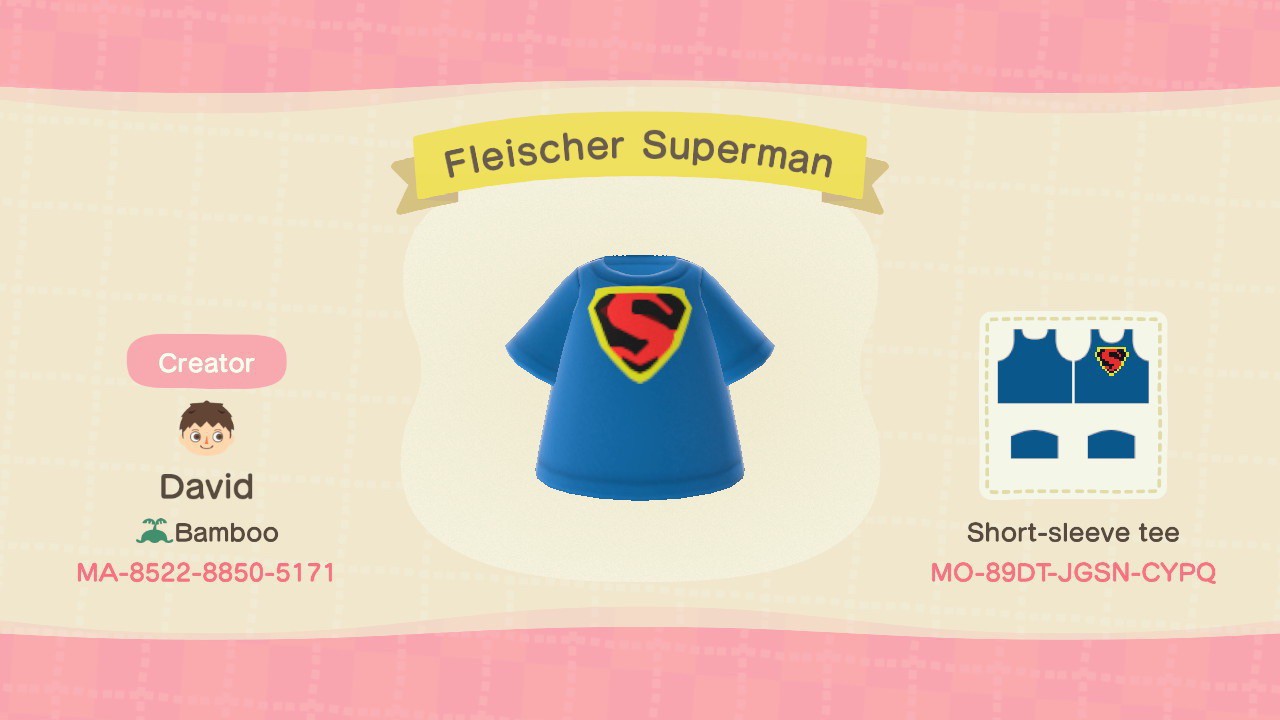
I made a Fleischer Studios Superman t-shirt for Animal Crossing: New Horizons. It looks great in-game. The colors and S-shape are taken from The Mechanical Monsters.
-
Here’s a summary of a 1701 account by Joseph Pitton de Tournefortof of a Vrykolakas (Greek vampire) terrorizing an island community. Lord Byron references the story in his notes on vampires.
-
A few summers ago I did some work fixing up the famous Superman shorts from Fleischer Studios. A fan uncovered the trailer that ran in theaters for the first short, which you can watch here.
-
A Bit More on Count Von Count
Inspired by this letter Children’s Workshop got about Count von Count, here are a few more tidbits about the maladjusted muppet.
One: A YouTube playlist of his early appearances, starting with his first.
Two: physically he resembles Bela Lugosi’s Dracula, adding in a beard and a monocle, a symbol of bygone mainland Europe aristocracy.
Three: Why does he count? We obviously have the pun on his title of nobility. More importantly, as his song goes, he’s called the count because he really likes to count, and there’s some obscure folkloric history there. (Also note that his song is rooted in the style of Eastern European folk music.)
Paul Barber’s Vampires, Burial, and Death: Folklore and Reality notes that in some areas vampires were believed to be arithmomaniacs. He says:
There is also a report of a tribe of Gypsies who believed that vampires could be kept out of the home by casting fishing nets over the doors: “Before the vampire can enter the house, he must count all the knots.”
Barber also mentions a compulsion to count poppy seeds, and that sometimes a person’s coffin would be filled with them to prevent the dead from rising. George Frederick Abbott’s Macedonian Folklore notes:
The visits of a vampire are further guarded against by scattering mustard seed over the tiles of the roof, or by barricading the door with brambles and thorn-bushes. […] The mustard […] is intended to make the Vrykolakas waste his time in counting. The same fatal weakness for arithmetic seems to best the Kalikantzari of Soutern Greece. If a sieve is handed to one, he will set to work to count the holes, as though his life depended on it. […] The Italians use a similar antidote on the Eve of St. John’s Day, when they carry about an onion-flower or a red carnation. This flower is meant for the witches, who are believed to be abroad on that evening. When it is given to them, they begin to count the petals, and long before they have accomplished this feat you are out of their reach.
-
Vampires in The Green Lantern: Blackstars
The second issue of The Green Lantern: Blackstars by Grant Morrison, Xermanico, and Steve Oliff has a few fun vampire references. I don’t intend to annotate the entire issue, but here are a few things I noticed.
The name of the space vampire queen, Belzebeth, calls to mind Biblical demon Beelzebub with a sprinkling of Elizabeth Báthory. Báthory was a Hungarian countess from the 17th century who allegedly tortured and murdered hundreds of young girls. Like Vlad Dracula, her story was connected to vampirism only after her death. Her coat of arms resembles that of the Order of the Dragon.
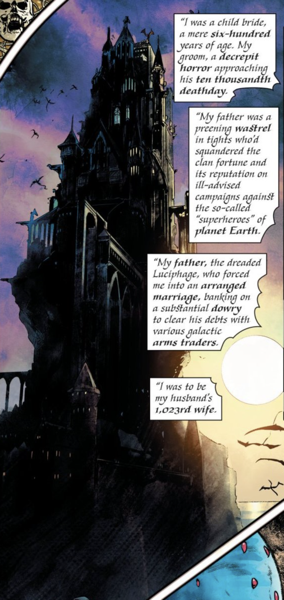
Her castle recalls many takes on Castle Dracula, though it seems to be sited on the water instead of above a chasm.
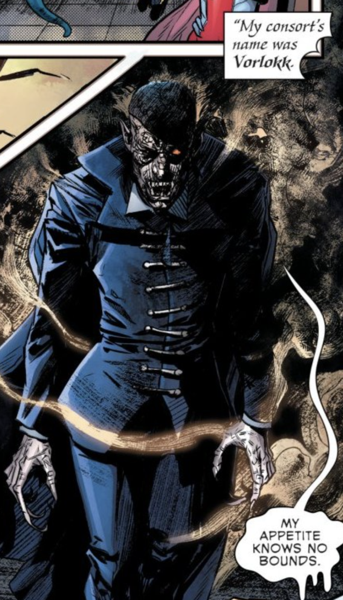
Her husband, Count Vorlokk, resembles Count Orlok from 1922’s Nosferatu: A Symphony of Horror, directed by F.W. Murnau, which was the one of the very first vampire films ever made and is a masterpiece of German Expressionism. Vorlokk turning into a Sun-Eater is a sensible if outrageous thing for a cosmic vampire to do. Sun-Eaters are DC universe creatures that do exactly what you think. He has a “cringing retinue of Renfields” (great language!). Renfield was the insane harbinger of Dracula in Bram Stoker’s novel.
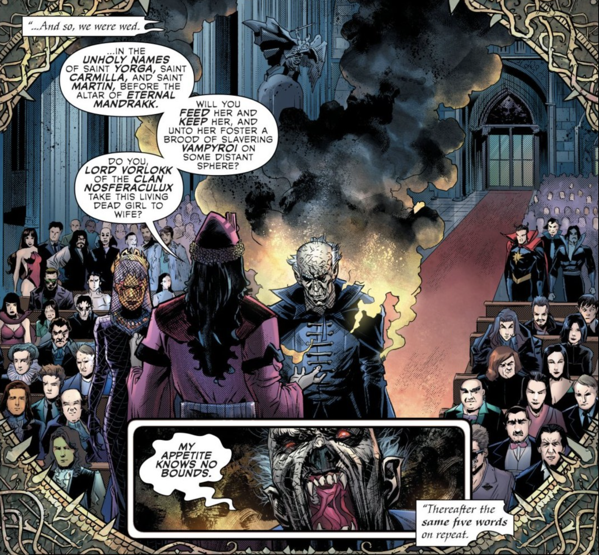
Their wedding namechecks 70s films Count Yorga, Vampire; “Carmilla,” which I talked about here and has been adapted into film several times; and 1978’s Martin directed by George A. Romero (most famous for Night of the Living Dead). “Mandrakk” is the villain of Morrison’s Final Crisis comic. He’s a corrupted version of the Anti-Monitor from Crisis on Infinite Earths who turns into a reality-eating vampire, and also an analogy for I guess comic book editors who have to make every story dark and gritty for the sake of short-term tales boosts. (Not relevant, but I just like to mention it.) The terms “Vampyroi” and “Clan Nosferaculux” are fun.
In the crowd are, among others, Brad Pitt’s Louis from Interview with the Vampire, Robert Pattinson’s Edward from Twilight, space vampire Vampirella, Morbius, the Living Vampire, the cast of What We Do in the Shadows, British half-vampire vampire hunter Blade, and more. The officiant is Vlad III Dracula (see his portrait on the Wikipedia page). I’m rather surprised I can’t pick out a David Bowie from The Hunger in the crowd.
-
Units of Measurement in Wallachia
Throughout Wallachia, whenever I refer to a distance, weight, etc., I try to use the era-appropriate word. So Laureline is a “nearly a palm’s width” taller than her older sister, not “4 inches.” Whether this successfully makes the story more immersive and adds an air of authenticity or it’s just annoying to read and off-putting is for you to decide. Here are the units I’ve used so far. All are listed in the glossary as well.
📏Distance:
- Poştă / poşti: 8 km (5 miles).
- Stânjen / stânjeni: 2 m (6.56 feet).
- Palmă / palme: 0.25 m (9.84 inches). 8 palme make a stânjen.
- Lat de palmă (palm’s width): Half a palmă. 12.5cm (5 inches).
Wallachia also had measurements for a pas mic (small step), 4 palme, and pas mare (large step), 6 palme, but I haven’t had occasion to use them. Wikipedia seems to indicate that Wallachia and Moldavia both used large steps but only Wallachia used the small one, so I’d probably use that if needed.
⚖️Weight:
- Oke / Okes: 1.25 kg (2.8 lbs). Variously this is oke, oka, or oca depending on the language. I’m using oke because that’s how it’s used in An Account of the Principalities of Wallachia and Moldavia.
- Dram: 3.25 grams (0.12 ounces).
💧Liquid:
- Oke / Okes: 1.25 liters (0.33 gallons) in Wallachia. (In Moldavia it was 1.5 liters.)
💰Currency:
- Piaşter / piaştri: The main currency in Wallachia, as minted by the Ottoman Empire. Equal in 1816 to 0.75 English shillings, with 26.67 making an English pound.
- Para / paras: 40 paras make one piaşter.
- Thaler: Used as the coins in Flowers of Transylvania. This was the coin of the Holy Roman Empire and Austria-Hungary. They often had lions on them. Wallachia minted them, too, and Romania’s current coin, the leu, gets its name from this lion. We get our word “dollar” from thaler.
📅Dates:
Wallachia was still on the Julian calendar, which was twelve days off the West. So Chapter seven (out tomorrow) takes place on 26 June (14 June old style). Here’s a handy calculator for converting the dates.
🌑Moon Phases:
Wolfram Alpha will tell you what phase of the moon it was for any given date. I don’t go as far as to get the weather right, aside from 1816 being a cold summer due.
I can’t guarantee any of this is actually accurate to the period, but I’m at least trying to be consistent.
-
Development Log: Fleurons part 2
As discussed previously, I use little fleurons to give the text a little bit of flourish here and there in the app. Page numbers are decorated with little left- and right-pointing floral heart symbols, but something bugged me about them. Here they are:

They aren’t the same size. Ack!
So in v1.2 I used Apple’s SF Symbols app to make my own custom floral hearts.

Much better.
In 1.1 I also made custom versions of the list.number and textformat.size buttons so that they’d use the Baskerville font to match the body text.

The news pages at the end of each chapter are set in San Francisco, the default iOS body font. I do this to make it visually clear that they’re back matter, not part of the story. In v1.2 on news pages the app now switches to using the stock buttons for table of contents and text formatting which matches the sans-serif on the rest of the page.
-
Wallachia v1.2.0
Big announcement: Wallachia is now completely free to read or listen to; no subscription required.
In place of a subscription paywall, there are little “pay what you like” buttons at the end of each chapter. You can support me by chipping something in after you read each chapter, or once a month, or whenever your lotto winnings come in, or not at all. For merely reading my story at all, you have my thanks.
Behind the scenes, I think this is the right choice going forward. There’s been a bit of a shift toward using the subscription model in apps, and I get why many people are unwilling to commit to an ongoing monthly fee, especially from an unknown author. I had envisioned Wallachia as something in the model of a magazine that you subscribe to in order to get new issues (or, to be precise, a penny dreadful). While I did pick up subscribers, I’m hopeful that making it free will get more people to experience my little historical, political vampire story.
1.2 is currently trickling down through the App Store. Depending on prevailing winds on the superhighway and traffic in the tubes, you should see the update soon.
Chapter seven is written but needs a bit of revision before it’s ready. Friday, probably.
Existing Subscribers
First of all, thank you for being here from the beginning!
I will be cancelling the current monthly plan soon. Once you’ve upgraded to 1.2, you can cancel it yourself using these instructions, or wait until the subscription ends on its own. Depending on when your next billing cycle starts, you might want to do it early. The reason I can’t end the subscription immediately is that 1.1 still stop working once I do and I want to give everyone time for the update to go through.
Developer Stuff
I played a little bit with SwiftUI for this version, but didn’t end up using the view I’d built in it. Originally I was going to have a “tip” page after each chapter asking for readers to optionally pay. I made a simple view in SwiftUI and it worked fine, but as I did my testing it felt too much like a nagging popup like you get on news sites. The design I settled on (little buttons at the bottom of the news page) feels less obtrusive and gentler.
Down the road, I have a much bigger update coming, but I think it’ll wind up being built in UIKit. I do a ton of stuff with
UITextViews and text stuff, and SwiftUI’sTextobject doesn’t let you do any formatting within the text. And even if it allowed you to set anNSAttributedString, I need the pagination stuff I get fromNSLayoutManagerso that I can show you a specific page of text at a time. I could embed it in hosting controller, but since the text view is like 90% of what you see, why bother? -
I’ve been making some videos about vampire-related things to promote Wallachia (and because they’re fun). You can find them here.
-
Count Dracula & Vlad the Impaler
Q: Is Count Dracula based on Vlad the Impaler?
A: In name only. Bram Stoker, writing in the 1890s, simply didn’t have access to much information about Vlad Țepeș. His character, Count Dracula, was an original creation who shares almost nothing with the historical figure aside from the name.
Until fairly late in the writing process, Stoker’s working title for the novel was The Un-Dead and his villain was “Count Wampyr.” That changed when he came across a brief mention of “Voivode Dracula” in William Wilkinson’s An Account of the Principalities of Wallachia and Moldavia: With Various Political Observations Relating to Them (Kindle). He thought the name sounded cool, so he changed his character’s name to Count Dracula. Nearly everything about the character had already been written before he ever heard the name “Dracula.”
Here, from Wilkinson’s book, is the entirety of what Stoker knew about Vlad Țepeș AKA Vlad III Dracula AKAVlad the Impaler, Voivode of Wallachia:
Their Voivode, also named Dracula,⁵ did not remain satisfied with mere prudent measures of defence: with an army he crosse the Danube and attacked the few Turkish troops that were stationed in his neighborhood; but this attempt, like those of his predecessors, was only attended by momentary success. Mahomet having turned his arms against him, drove him back to Wallachia, whither he pursued and defeated him. The Voivode escaped into Hungary, and the Sultan caused his brother Bladus to be named in his place. He made a treaty with Bladus, by which he bound the Wallachians to perpetual tribute; and laid the foundations of that slavery, from which no efforts have yet had the power of extricating them with any lasting efficacy.
[…]
5. Dracula in the Wallachian language means Devil. The Wallachians were, at that time, as they are at present, used to give this as a surname to any person who rendered himself conspicuous either by courage, cruel actions, or cunning.
(The bit about “slavery” refers to Wallachia’s status as a suzerainty of the Ottoman Empire. It joined with Moldavia in 1859 to form Romania, which gained its independence from Turkey in 1877.)
In the 1890s, Vlad III Dracula just wasn’t a prominent enough figure in the English language tellings of the region’s history to have gotten more than that one paragraph and footnote. Wilkinson’s history mentions the word “Dracula” two other times in connection with Vlad II Dracula, who was the father of “our” Dracula, though he doesn’t seem to have known that. None of the other books Stoker read mention him at all. He was just another in a long line of bloody warlords.
Stoker did make use of this info, however. In chapter three, Dracula goes on a rant about the history of his people, including:
Who was it but one of my own race who as Voivode crossed the Danube and beat the Turk on his own ground? This was a Dracula indeed! Woe was it that his own unworthy brother, when he had fallen, sold his people to the Turk and brought the shame of slavery on them! Was it not this Dracula, indeed, who inspired that other of his race who in a later age again and again brought his forces over the great river into Turkey-land; who, when he was beaten back, came again, and again, and again, though he had to come alone from the bloody field where his troops were being slaughtered, since he knew that he alone could ultimately triumph!
In chapter twenty-eight, Van Helsing surmises:
He must, indeed, have been that Voivode Dracula who won his name against the Turk, over the great river on the very frontier of Turkey-land. If it be so, then was he no common man; for in that time, and for centuries after, he was spoken of as the cleverest and the most cunning, as well as the bravest of the sons of the ‘land beyond the forest.’
“The Land Beyond the Forest” is a nickname for Transylvania, from the Latin roots trans, “beyond,” and sylva, “forest.” It’s also the title of Emily Gerard’s book about the country (Kindle, Apple Books) which, along with her Transylvanian Superstitions (Kindle, Apple Books), were major sources for Stoker.
If we assume that Van Helsing is correct, then Count Dracula is the historical Voivode Dracula, but in name only. Stoker didn’t know his name, Vlad, and didn’t know anything about him having people impaled. It’s hard to imagine him leaving those sorts of details out if he’d known about them.
I’ll recommend a book about Dracula (and Dracula) in a moment, but first a few words about Wilkinson and Gerard’s travelogues, which were important sources for Stoker. First, they’re pretty dry; Wilkinson reprints old military treaties. Second, they’re exceptionally biased. These are books by British writers who went to Eastern Europe and thought of the people there as dirty and uncivilized. One sampling from Gerard’s book: “Were the whole world people by this race alone, our dictionaries might have been lightened of a good many unnecessary words, such as elegance, grace, fascination, etc. Of course, now and then one comes across an exception to this general rule and finds a pretty girl, like a white poppy in a field of red one; but such exceptions are few and far between, and I have remarked that on an average it takes three well-populated villages to produce two bonnie lasses.”
While interesting for research purposes, these are not books that seem very interested in widening their readers’ points of view through travel. Stoker’s book reflects this slant, and can easily be read as a horror story about a foreigner coming to London to pervert its women and infect England with his impure blood.
In a small way, Wallachia is my attempt to treat the people of this region with the dignity Stoker and his sources did not. Most of Marley’s neighbors might be illiterate, but they’re good people at heart. I also try to keep Count Dracula pretty close to Stoker’s as I write him, though I couldn’t resist including a few good impalings in Flowers of Transylvania.
If you’d like to read more, Dr. Elizabeth Miller’s A Dracula Handbook (Kindle, Apple Books) is an excellent starting point. I could have just quoted from her directly for all of this post—her book includes entire chapters on this stuff—but I’ll at least let her have the last word. One enduring myth is that Vlad the Impaler was a vampire, or was believed to have been one at the time. Miller includes a number of contemporary accounts of his life and exploits (which, again, Stoker didn’t have access to) and, on the question of whether Vlad was ever connected with vampirism, says:
The word “vampire” was never used in connection with Vlad until well after Bram Stoker’s novel appeared and it became popular to assume (incorrectly) the Vlad was Stoker’s inspiration for his vampire Count.
-
The Vampyre and Carmilla
Both The Vampyre and Carmilla are in the public domain. You can download ebooks of them for free using the links below.
The Vampyre; a Tale (Kindle, Apple Books). I also highly recommend this collection by Andrew Barger that includes The Vampyre: The Best Vampire Stories 1800-1849: A Classic Vampire Anthology (Kindle, Apple Books).
Carmilla (Kindle, Apple Books). If you like Carmilla, also check out Le Fanu’s collection In a Glass Darkly (Kindle, Apple Books).
Lastly, if you’re into 19th century-set vampire stories, you’re welcome to read my own book, Wallachia, A Penny Dreadful. The prelude, Flowers of Transylvania, is available on Kindle and Apple Books for $2.99. The main story is published as a serial in text and audiobook formats via an app I designed. New chapters come out every few weeks and subscribers get to vote on upcoming story developments as I write them. Download on the App Store.
-
The Yellow Line
I’m not much of a sports fan. I like baseball and tennis, but I don’t have cable so I only watch either occasionally (though I’m very excited for the Nationals this year). I hardly ever watch football; not even the Super Bowl. I like the yellow line, though. This piece about sports graphics made me think about it again.
My sister’s husband, Tom, invented the yellow line, you see. Well, he probably didn’t invent invent it, but he worked for one of the companies that was doing sports graphics when the yellow line came about and (I think) has a patent on it. He’d go to games and sit in the production van and run the program that drew the first down line onto the field. There was a lot of math involved, making sure that it looked good as the sun and shadows changed the color of the field during the game. Making sure it didn’t bleed onto the players. He wasn’t even a football fan, Tom, but he found it to be an interesting problem.
Years after he left that job, we’d be somewhere where football was on, and sometimes he’d comment on how his version of the line was better than the one being used on that particular broadcast. Not in a bragging way, just in the sort of way that said, “Oh, I had that problem they’re having, and I figured it out.”
We lost Tom to cancer last year, but whenever I happen to see that yellow line, it makes me think of him, in that production van, not caring much about the sport but trying to put on a good show. 🏈
-
Gay Characters and Homophobia in Wallachia
My wording in the video, that I “realized” Ion and Kwasi were gay, is intentional. The first characters I came up with were Marley and Dracula, and Negrescu Radu, with the basic story of Dracula coming to the village to exert his influence on the local lord there, and Marley as the villager who will be affected by whatever goes on there. As I expanded the cast, it wasn’t that I decided, “I’m going to have a gay couple!” Rather, with Ion and Kwasi, they just sort of came out that way (pardon the pun).
Somewhere on Twitter years ago I saw someone say that when you’re writing a fantasy novel, you get to decide what the biases of your characters are. Do you have elves or whatever? It’s up to you whether the human characters are elf-racist or not. It’s your world, after all.
This stuck with me as I developed my story with Wallachia. I had several plot threads I was mapping out, and sort of just didn’t want to take the time to also include stuff involving Ion and Kwasi having to hide their sexuality. More, I wanted the character conflict that arises to come from the choices they make, not who they are.

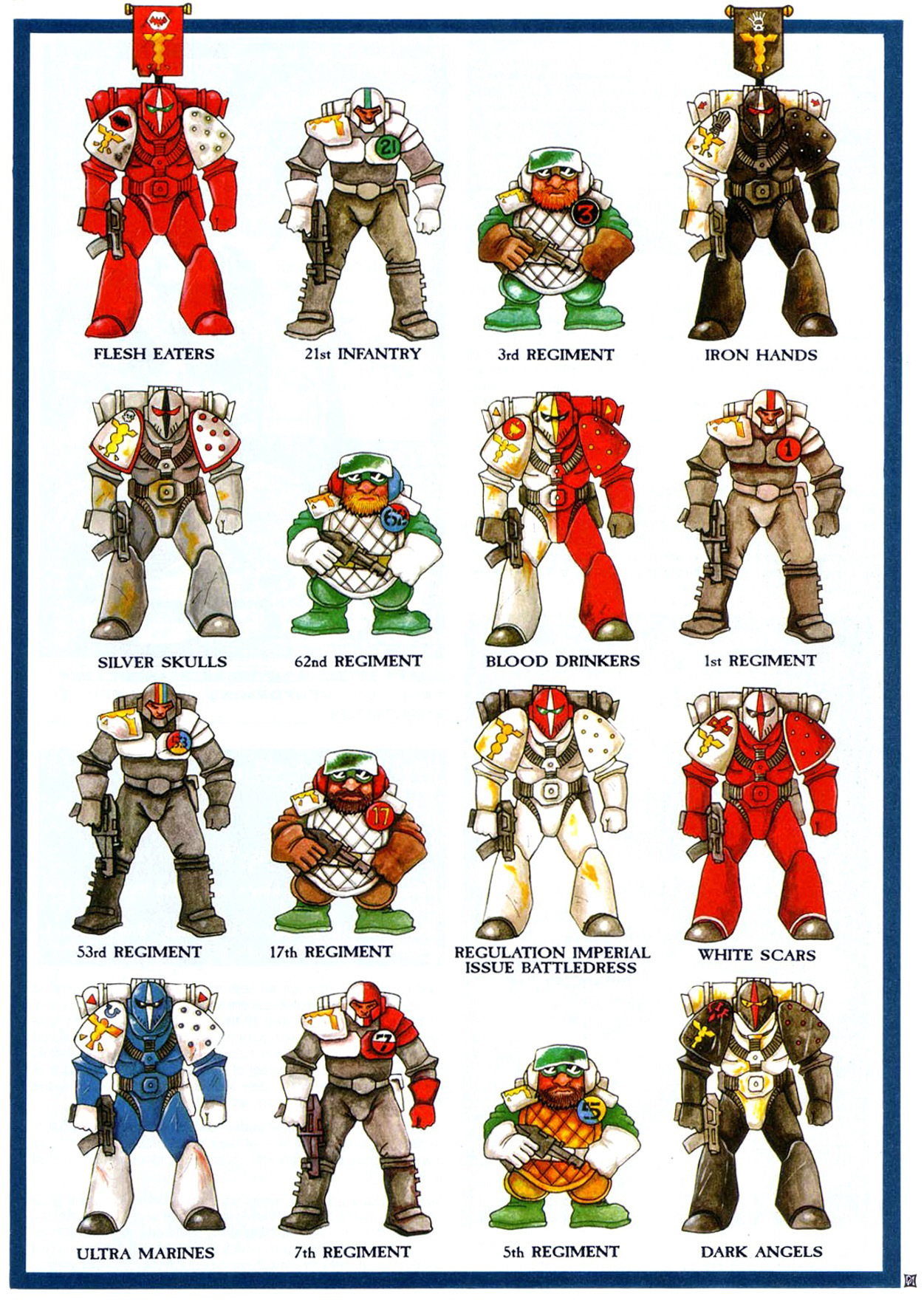


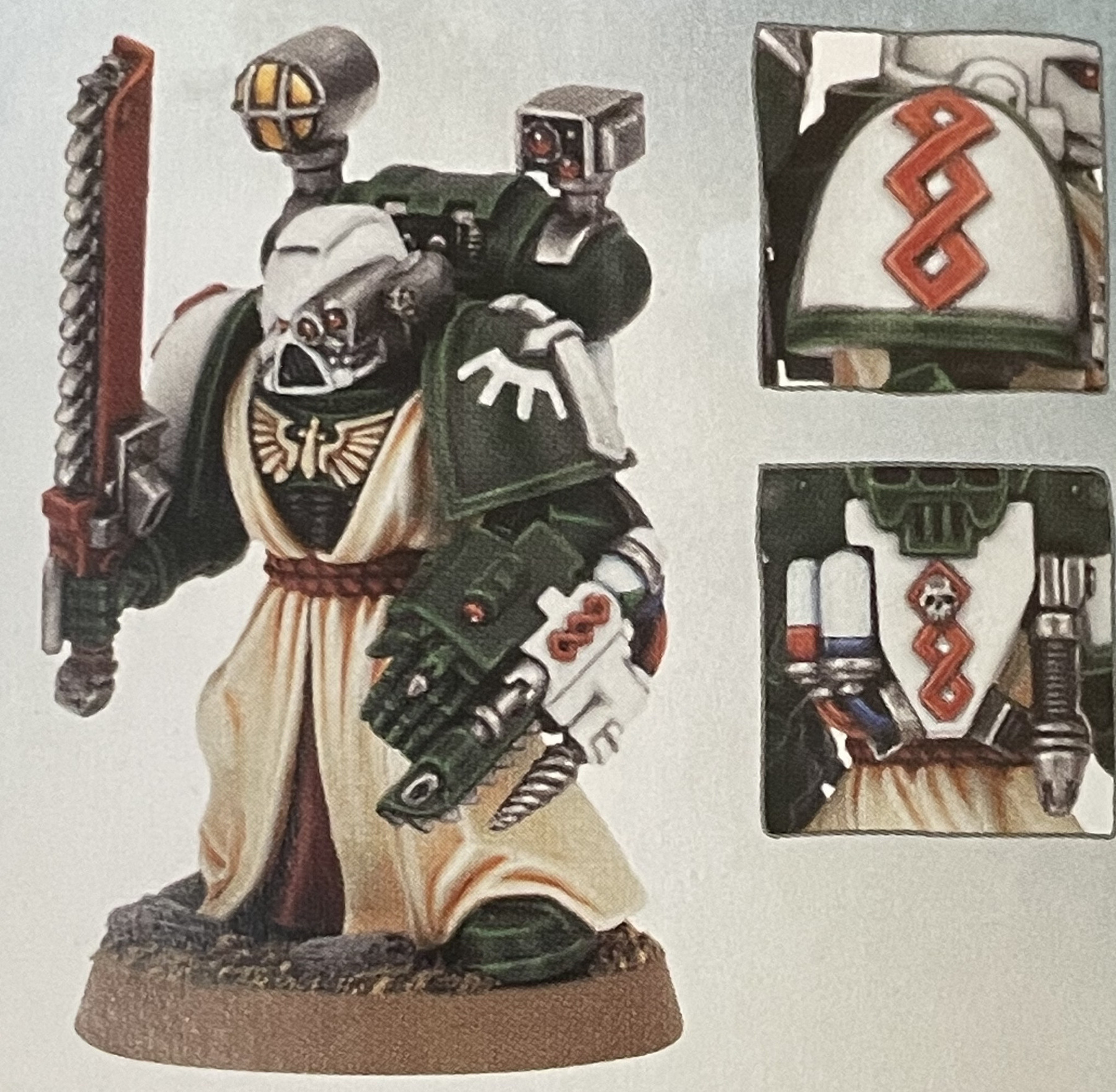


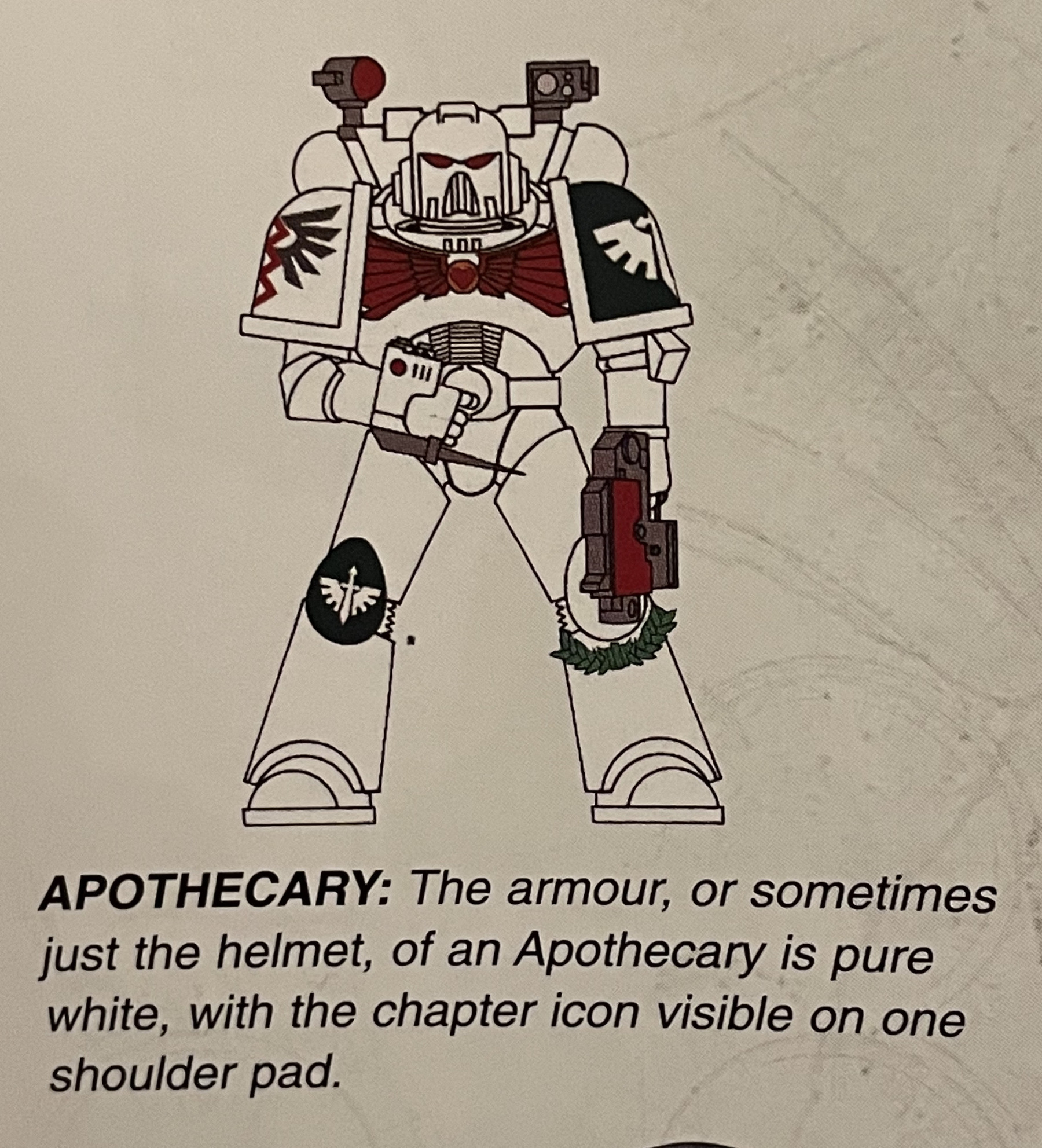

subscribe via RSS