-
The Ravenwing, the Dark Angels' Cavalry
Or, “Can I Make My Assault Marines/Inceptors/Infiltrators/Stormtalon Ravenwing?”
The Dark Angels’ Ravenwing company is as mysterious in the lore as it is misunderstood in real life. There are two common misconceptions about the Ravenwing I wanted to clear up in this piece. First, the Ravenwing are the Dark Angels’ cavalry company, not their fast attack company. Second, I’ll touch on the role of aircraft within Space Marine chapters and the Dark Angels in particular.
Interestingly, while Deathwing Terminators are probably the Dark Angels’ most recognizable unit, the Ravenwing were one of the very first aspects of the chapter to be established. White Dwarf 96 (December 1987):
Number seven company is a specialised recon and attack company, known as the ‘Raven Wing’. Instead of the usual Dark Angel motif, Brothers of the company sport a black wing overlaid by the company number on the right shoulder armour. Equipped and trained for high-speed reconnaissance, the Raven Wing specialises in hit-and-run warfare and search-and-destroy missions.
When the chapter’s full story was written for Codex: Angels of Death in 1996, the Ravenwing, now the second company, received a new mission, fitting in with the Dark Angels’ new backstory (p30):
The Ravenwing is the name of the 2nd Company of the Dark Angels Chapter. It is a highly specialised formation used for scouting and assault missions where speed is more important than heavy firepower. To this end, all of the Space Marines in the company ride on bikes or land speeders, which are organised into special units called squadrons, each consisting of up to five vehicles.
Instead of the usual dark green panoply of the rest of the Chapter, the Ravenwing’s vehicles and armour are painted jet black, and it is this which gives the company its unique name. Equipped and trained for high-speed missions, the Ravenwing excels at hit-and-run warfare and search-and-destroy operations. The last type of combat mission is highly important to the Dark Angels because when they are operating against any of the Fallen, it is vital that not one of the enemy escapes to fight another day.
The 4th edition codex (p17) adds:
Although only the company’s highest-ranked officers know it, the Ravenwing’s primary role is to hunt down and capture the Fallen Dark Angels. Therefore, the members of the 2nd Company are granted limited knowledge of the secrets of the Dark Angels — much more than the 3rd to 10th companies, but far less than the Deathwing and the Inner Circle. Detached Ravenwing squadrons range far and wide, their overall mission dictated by the Inner Circle. Intelligence is gathered, leads tracked down, and word passed back to the Chapter’s shadowy masters. Then, the order is given, the target is assigned, and the Ravenwing descend upon their victim.
The Ravenwing might go decades with little or no success achieved in tracking down their targets. […] very rarely, the Ravenwing might locate a concentration of targets, perhaps an entire band of Fallen Dark Angels. At this point, they will call in the Deathwing, who will teleport from orbiting spacecraft.
From the very start, Games Workshop establishes that the Ravenwing primarily deploys on bikes or land speeders. The company’s role is that of a cavalry force: mounted reconnaissance, fast assaults, and prolonged pursuits. While there are other Space Marine units that also fill these roles, like assault marines or Phobos squads, they have never been part of the Ravenwing*. The reason for this is mostly tradition, but it makes some degree of sense when you consider their more secretive role. The Dark Angels need guys on bikes who can quickly pursue their quarry. A Phobos squad might be able to range forward and scout, but couldn’t engage in the same level of chase and wouldn’t be expected to carry a teleport homer it might never need, where this equipment could easily be stored on a bike. Assault marines can engage quickly but don’t have the same range and independence as a bike.
(Then again, there are lots of places a Fallen Dark Angel could run that a bike couldn’t follow. Indeed, the novel, Ravenwing, depicts exactly this. Is it reasonable that for a given mission the Ravenwing might deploy on foot as another squad type? Sure. This is the difference between a set of game rules, which has a restricted number of units, and a story, where anything can happen.)
2012’s sixth edition added aircraft to most armies. Page 20 of that year’s Codex: Dark Angels says, “the majority of the Space Marines in the company are deployed to battles on bikes, with the remainder piloting some form of Land Speeder or fighter aircraft.” Regarding atmospheric fighters, page 50 says:
To pilot such swift attack craft, the Dark Angels have naturally turned to the Ravenwing — for the 2nd Company cultivates the skills needed for such rapid manoeuvres. Ever since its founding, all members of the Ravenwing have been trained to pilot any of the vehicles their company utilises in battle; however, it is the oversized 2nd and 3rd squads that have traditionally served as the front-line pilots.
This edition adds two Ravenwing-specific airplanes: the Nephilim Jetfighter and the Ravenwing Dark Talon.
On the Nephilim Jetfighter, the codex says that while they are “sometimes given the task of escorting Thunderhawks to their drop sites, the main role for the Nephilim is as an interceptor to establish air superiority over the battlefield, allowing their brethren to concentrate on ground targets with little concern for aerial assault.”
The Dark Talon’s job, in contrast, is to attack ground sources, with the added task of transporting captured Fallen:
In addition to its mighty arsenal, the Dark Talon carries a static-crypt holding cell. It is into these awful confines that the Dark Angels’ captives are loaded so that they might be ferried up to the orbital fleet and, ultimately, to the dungeons of the Rock and the attentions of the Interrogator-Chaplains.
2016’s Death from the Skies supplement, page 10:
The Dark Angels are unusual amongst the Chapters of the Adeptus Astartes in that their aircraft are not piloted by the Techmarines of their Armoury. Instead, these agile hunting craft are flown into battle by the expert operatives of the Dark Angels 2nd Company, the Ravenwing.
It goes on to say that the pilots are trained to “fly the infamous Nephilim Jetfighters and Ravenwing Dark Talons that make up the Dark Angels air force.”
Is this passage meant to be saying that the chapter’s air force is entirely comprised of those two types of planes? We know it isn’t, because Thunderhawks were mentioned in the 2012 codex. The answer comes in 2017’s Codex: Dark Angels, which depicts a green, 5th company Stormraven on page 61. Page 126 provides its rules, which do not include the Ravenwing keyword.
Taken together, my conclusion is that while the Ravenwing do maintain a set of aircraft, they are not the entirety of the Dark Angels’ air force. Troop transports are greenwing or Deathwing. Other craft meant to escort these transports or intercept enemy fighters are likely greenwing, piloted by Techmarines (Stormhawks etc).
The role of 2nd company aircraft, then, would mirror that of their better-known ground forces: engagements where veteran pilots are needed, and anything involving the Hunt. Dark Talons transport the Fallen; Nephilim protect the Dark Talons. A random Stormraven carrying some tactical squads has no role in the Hunt, so it would be Greenwing. (But one carrying Deathwing could well be operated by the 1st company in the same way that it maintains its own Land Raiders.)
(Undefined in any book I’m aware of is how exactly bikes and land speeders get to the surface from their voidships. There are presumably Thunderhawks or other drop ships that carry these, which may be maintained by the Ravenwing and their assigned Techmarines.)
* Referring to 40K lore here. The Ravenwing were later retconned to have been one of six “wings” of the 30K Legion. That version of the Ravenwing included infantry, tanks, etc. and served a different role than its modern descendant.
More Dark Angels stuff I’ve written:
- Shoulder Pads of the Dark Angels
- Dark Angels Apothecaries
- Why the Dark Angels Really Changed from Black to Green?
- How the Dark Angels story developed, from Rogue Trader to 2nd edition
- Successor Chapters
- My 4th company, “The Feared”
- The Deathwing: History and Complement
- Dark Angels Decals: A Look at Waterslide Transfer Sheets
- The Ravenwing, the Dark Angels’ Cavalry
-
Games Workshop announced today, as I had guessed, that it will be releasing its own, official Kill Team app when the next edition launches in the fall. I don’t expect there to be a need to continue development of Teammate in light of this, unless I see an obvious gap in its functionality that I feel needs its own mobile app. I don’t plan to pull Teammate any time soon, so you can keep using it for your games and campaigns, but I don’t anticipate releasing any new versions.
I’m incredibly happy with the product that I was able to build, and going to a tournament and meeting people who use the app was always a delight. I’ll be at Nova Open next week and New York Open in October. See you around!
-
Teammate 1.2.14
The Brood Brother and Hernkyn Yaegir teams, and the Termination missions are now available to use in Teammate. I expect to be making an update in another week or so with the next Balance Dataslate so please let me know if any bugs slipped by.
1.2.14
- Termination: Brood Brother and Hernkyn Yeagir teams are now available.
- Shadow Operations: Missions from Kill Team: Termination are now available.
- Mandrake: Shadow’s Reach Tac Op is now disabled in Close Quarters games (per 1.0 Errata).
-
Teammate 1.2.13
Just two small bug fixes in this update.
1.2.13
- Matched Play: Fixed a bug that prevented Tac Op scores from resetting between games.
- Game History: Removed the erroneous Matched Play Copy Score button from Spec Ops games.
-
Teammate 1.2.12
In addition to adding the teams and missions from Kill Team: Nightmare, this edition adds fun emoji score grids that you can share after your matches:
Nemesis Claw (18) vs Mandrake (16)
🟠🟠🟠⚫️⚫️⚫️
🟠🟠⚪️⚫️⚫️⚫️
🟠🟠🟠⚫️⚫️⚫️
🟠🟠🟠🟠⚪️⚫️🟧🟧 ⬛️⬛️
🟧⬜️ ⬜️⬛️
🟧⬜️ ⬜️⬛️🖌️🖌️ 🖌️🖌️
Shared with Teammate: Kill Team Aide
When you click “Finish Game” after any match, the emoji score sheet will be copied to your clipboard so you can paste it into a text, social media, Discord, etc. You can also get a score sheet back by going into your team’s Game History for any game played with this version or later.
1.2.12
- Nightmare: Nemesis Claw and Mandrake teams now available.
- Shadow Operations: Missions from Kill Team: Nightmare are now available.
- Score Recap: Finishing a game now copies your score to the clipboard so you can share it online.
- Game History: Games played with version 1.2.12 or later will show a button to copy the score to your clipboard.
- Quick Score: Added a Clear Score button to the toolbar. The quick score sheet will remember your score until you click Finish Game or clear the score manually.
- Score Sheet: The score sheet is no longer a pop-up.
- Spec Ops: Choosing a mission will now automatically set the appropriate game type (open, close quarters, hazardous areas) for Tac Op selection.
-
Teammate 1.2.10
This update fixes an important bug where attempting to delete a Spec Ops team might instead delete a Matched Play team.
1.2.10
- Fixed a bug where deleting a Kill Team could delete the wrong team.
- The top screen show has separate buttons for creating matched and spec ops teams.
- Spec Ops: The pre-game operative selection section now defaults to its expanded state.
- Spec Ops: The picker when assigning TacOp xp now shows each operative’s type after its name.
-
Teammate 1.2.9
Just a small update this week fixing two Spec Ops bugs and updating the artwork for Bheta-Decima. With the Scout Squad, loyalist Space Marines now have enough teams available that they were making the Imperium pulldown menus too long, so I’ve brought them out into their own category where relevant.
1.2.9
- App icon and background images are now set on Bheta-Decima.
- Space Marines now have their own category in Faction menus.
- Novitiate: (Spec Ops) Added Staunch to Novitiate Superior’s available specialisms, and removed Scout.
- Wyrmblade: (Spec Ops) Fixed a bug where Cult Agents couldn’t pick Wyrmblade-specific Battle Honors.
-
Codex: Dark Angels (2024)
I’ve read through the 10E codex. Here are a few observations.
Deathwing vs Inner Circle: It explicitly says that the Deathwing is the first (outermost) ring of the Inner Circle. It’s okay to use those terms synonymously. Also, it mentions that Interrogator-Chaplains take “the solemn vow of the Deathwing,” further muddying the distinction between the two terms. For clarity’s sake I think it’s still best to use “Deathwing” to mean current members of the first company and “Inner Circle” to mean higher-ranking Deathwing and assorted other officers.
We also get further confirmation that not all Chapter Masters are necessarily in the Inner Circle.
Bladeguard, Sternguard, and Vanguard Veterans: The passage on the Deathwing opens, “The Dark Angels outfit their entire 1st Company—the Deathwing—with Terminator armour, lightning-wreathed power weapons and towering relic shields.” Boy do I hate using a comma splice to interpret a passage—my Republic for a full stop after “armour.” Not every Terminator carries power weapons or relic shields, but Bladeguard Veterans do. There’s no further mention of the lesser, non-Terminator veteran squad types, and not even a small passage saying, “Azarael decided that since Games Workshop included Bladeguard and Sternguard in starter boxes, he has to let them into the Deathwing.” But The Unforgiven rule on page 59 does give them all the Deathwing keyword, so you’re free to paint them in bone white and use Deathwing stratagems on them.
Ravenwing Aircraft: The Ravenwing section (oddly on the page before the Deathwing) puts the Dark Talon and the Nephilim Jetfighter as those “among” the “the Dark Angels’ arsenal of sleek aerial fighters.” The above-mentioned Unforgiven rule gives the Ravnewing keyword to all aircraft, so if your Sammael wants a few other planes in black, go for it.
Units without Models: Talonmasters and Strikemasters have their own sections, but no rules. Interrogator-Chaplains do not have their own section (they did on previous codexes) but do have decals on the included transfer sheet. GW’s been pretty consistent on this lately: if a unit doesn’t have a model, it isn’t going to have rules.
We’re getting some very cool models in this wave. My wishlist for future releases, in order of preference, would be:
- Black Knights (outrider-sized)
- Interrogator-Chaplain
- Talonmaster kit (or a suitable upgrade to Storm Speeders)
- Ezekiel
- Deathwing Command Squad
- Sammael in plastic
- Strikemaster
Fluff and Lore: Overall the book is fine but could be a bit heavier on the story elements. The fall of the Dark Angels is brief and to the point. The events of the Lion, Son of the Forest and Arks of Omen are summarized but the story doesn’t progress from there. The only new addition is the Inner Circle Companions who are not quite said to be the Lion’s crew of Risen. We do get a bit more color on the story from White Dwarf that shows the Lion occasionally intervening in Fallen interrogations. The storytelling in the 2E book was probably the best; the amount of material in the 5–7E codexes is unlikely to be matched again.
On Supplements: I wish this weren’t a supplement to Codex: Space Marines. I think it complicates balance for that book, and requires making design and balance compromises for the divergent chapters. Instead, my preference would be this: if you want to use one of the detachments from C:SM (Gladius, Ironstorm, etc), go for it, but you can only use units from that book. Your Deathwing Terminators are just regular Terminators there. Your bikes are regular bikes. No Deathwing Knights, no Black Knights, no Dark Angels characters. Likewise for Blood Angels, Black Templars, Space Wolves, and Deathwatch. It would allow GW to balance that book on its own merits without having to worry about competitive players cherry picking strong units from a supplement.
In turn, the lists in these supplements could be much more limited but more flavorful. Think World Eaters, Death Guard, and Thousand Sons—they can’t take normal Chaos Space Marine units, but instead they get a smaller set of options that are heavily themed to their Legions. What I’d like to see for loyalist supplements are major restrictions: prevent Black Templars from using Intercessors, Assault Intercessors, and Scouts in favor of Crusader Squads. Then make Crusader Squads really good. Replace Space Wolf squads with their Long Fang, Bloodclaw, etc. equivalents. Let Space Wolves be Space Wolves.
How would I handle Dark Angels? I’d strike most greenwing units that overlap the purpose of Deathwing and Ravenwing. If you want tough, slow infantry, you take Terminators, not Gravis. (Remember, if you have lots of Gravis models you want to use, you can still run them in C:SM detachments.) If you want fast guys with chainswords, you take bikes, not jump packs. For fun, maybe also replace Intercessors with Dark Angels Intercessors and let each squad take a Hellblaster for every five models, and give them a special sergeant with a Calibanite power sword (and letting GW sell extra Inner Circle Companions to be painted green with bone robes).
I could go on, but the general idea is focus. The fewer units an army has access to, the more focused it can be. The more focused it can be, the better GW can tune each unit. Outriders could be replaced with Ravenwing Outriders and have more attacks and/or stronger chainswords. Deathwing Terminators could be true terrors. Chaplains could be monsters. Librarians could have different abilities. And everything would be contained in one nice book.
All that said, you can do some of this yourself by just leaning into Dark Angels-specific units in your lists. But because every supplemental unit has to remain compatible—and balanced alongside—every vanilla unit, I do wonder if it limits GW’s ability to really let loose.
Combat Patrol: The new Vengeful Brethren combat patrol is as strange as the we thought it was when the rumors came out. I like this mode a lot. If haven’t tried it, or don’t take it seriously, I think you’re missing out. I know that the point of these boxes is that they’re not supposed to overlap heavily (Intercessors aside) with the other combat patrol sets. But overall I think Octavius is the most Dark Angel-y box, especially if you substitute Belial in for the captain.
The Rules: I haven’t mentioned the actual gameplay stuff so far, because I’m not that worked up about it. Partly because I mostly play Kill Team these days which is, in my opinion, a much better, more tactical game. But also because GW can just change the points and buff units whenever it feels like it needs to. Better an undertuned force that can be brought up than an overpowered one that makes everyone hate Dark Angels for several months.
-
Dark Angels Decals: A Look at Waterslide Transfer Sheets
How about an (unfortunately somewhat dry) look at Dark Angels waterslide transfer sheets!*
Here’s the default sheet that has been included in most DA kits over the last decade or so.
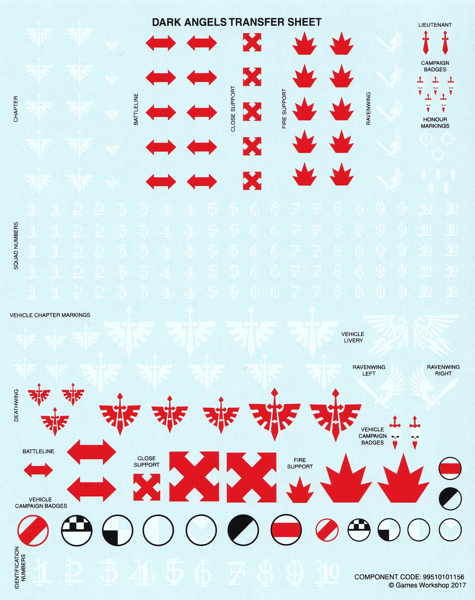
Going from left to right, we have chapter badges, which tend to go on the marine’s left shoulder (or the right if he has MKVI-style studs on his left shoulder), with smaller versions for old-style scouts. Of course you can stick these on vehicles, dreadnoughts, etc. as well.
Next are decals for battle line, close support, and fire support. See here if you need a refresher on which squads are which. They go on the model’s right shoulder with a number on top of them.
(For these an all decals, I highly recommend you get Micro-Sol and Micro-Set solutions and watch a video or two on how to use them. For the squad types I varnish with ’Ardcoat, apply decal with sol+set, varnish again, apply number, varnish again with Stormshield. Yes, it takes forever.)
Next we have Ravenwing symbols that go on the left shoulder of Ravenwing models, and if you have spares they can go wherever you think looks good on bikes, speeders, etc.
The red sword goes on the right pad of Lieutenants. I think the point should be facing down. Newer manuals use the red sword face up for veterans. Older ones show a white sword facing down, but no recent decal sheet has provided them—2014’ Forge World sheet had white swords among those labeled for veterans; 2017’ Dark Imperium sheet had them in the campaign badges section.
Campaign badges are next. This sheet uses the red sword with skull, but there are a few variations on other sheets, such as a white skull in a red triangle. Annoyingly there are only five on the sheet. Insignium Astartes 64, Games Workshop 2012:
Space Marines do not always fight alone and often find themselves going into battle alongside other Imperial forces. The mass ranks of the Imperial Guard form the major portion of any allied contingent and include huge tank divisions as well as enormous numbers of foot troops. Other Imperial organisations can and do supply warriors and war machines to the war effort. These include the mighty titan war machines of the Adeptus Mechanicus, the warrior nuns of the Adepta Sororitas and a host of other units and individuals.
When an army of the Imperium goes to war it is standard practice for the Imperial Commander or general to choose a symbol to act as a campaign badge in accordance with the regulations set down in the Codex. This “field sign” is known as the Army Badge and serves to identify all the troops and equipment that are operating under his command and helps them recognise friendly units on the battlefield. The Army Badge is painted onto Space Marine armour and Imperial Guard tank alike. Cloth patches may be sewn onto Imperial Guard fatigues. Huge versions of the badge will be stencilled onto the gigantic armour plates of Titans. Each time the badge is applied the recipient receives a blessing from the Company Chaplain if a Space Marine or from an attached member of the Imperial Ecclesiarchy if serving in one of the other Imperial forces.
The design of an Army Badge is deliberately quite straightforward. Usually it consists of a simple geometric shape overlaid with a motif or it might be a simple stencilled icon. The Army Badge must be instantly recognisable if it is to function as a battlefield identification. Space Marines generally apply the Army Badge to their right leg greave.
The Army Badge is only used for the duration of a single campaign. Once this is over the various forces that comprise the Imperial Army are dispersed and the Army Badge is either removed or replaced. If a squad, regiment or indeed an individual warrior has performed exceptionally in the campaign, the Army Badge may be incorporated onto their armour, uniform or heraldry as a permanent honour. This is particularly true of banners and standards and many of the lavish designs seen on Chapter, Company and personality banners are, in part, derived from the Army Badges of previous campaigns.
The Indomitus campaign has its own symbol that you’ll see on many sheets.
For Honour Markings we have a round symbol that resembles an Iron Halo:
A Marine who demonstrates exceptional initiative will be awarded the Iron Halo. This badge has its origins in the earliest days of the Imperium. It is either painted or etched onto a Marine’s armour and coloured red. It also appears as an element of many Chapter and Company banner designs, presumably recording occasions when the Company or Chapter has demonstrated initiative beyond expectation. [Ibid]
Below that, the Marksman’s Honour:
This device is the Marksman’s Honour. Acts of remarkably accurate shooting or consistent performance with targeting are marked with this award. The Codex insists that those warriors who prove their accuracy in combat should be singled out so that their skill may be instantly commanded when necessary. The badges themselves are believed to have been constructed by encasing in gold bolter shell cases fired in battle from the bolt gun of Roboute Guilliman himself. [Ibid] †
You’ll see these hanging off the shoulder pads or belts of some models as well.
Next of course are numbers for the right pauldrons.
Vehicle chapter markings can go anywhere you’d like. I’ve looked and haven’t ever found “proper” markings for tanks. The most common version seems to be to put a vehicle number on the front of the tank on its left, company marking on its right, and if it’s a transport it can optionally have the symbol for its squad type (battle line, close support, fire support) on the sides. The double-headed imperial eagle labeled “vehicle livery” looks good on either side of swing doors or on the front hood.
Deathwing symbols go on Terminators’ right shoulders. The larger ones can go on Land Raiders or Dreadnoughts.
Finally we have larger campaign badges, numbers, and company symbols that, again, you can put wherever you like.
Going all the way back, here’s the transfer sheet from the original release of Warhammer 40,000.
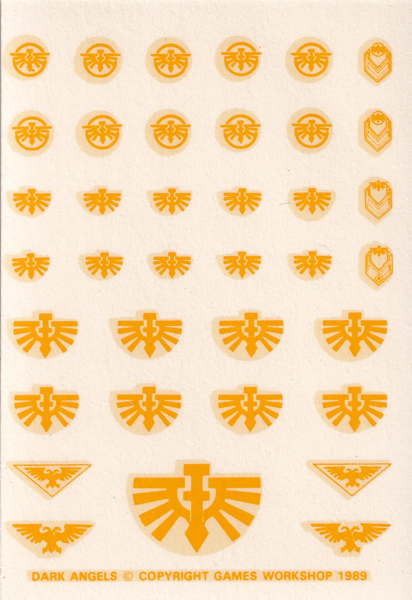
They came in yellow (pictured), red, and white. The early Dark Angels models were shown in black, and even now the Horus Heresy colors maintain that color scheme, but the red has never showed up well on black armor. Note the combined Dark Angels badge and sergeant stripes on the right. Also, at the time, the Dark Angels logo was meant to be a winged dagger. It’s now more commonly shown as a sword.
Each 40K starter set has come with a multi-purpose transfer sheet for Space Marines.
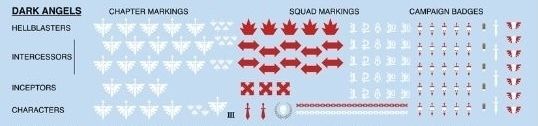
Dark Imperium (8th edition) has the standard symbols from above. It add some tiny Dark Angels chapter badges, which will fit on foreheads, the corner of pauldrons, boltguns, kneepads, or anywhere you’d like.
It has an Imperial Laurel:
A Marine who bears this honour has literally won his laurels. Acts of valour leading to great victory are deeds rewarded with the Laurel Wreath. The wreath is often worn as a crown or sculpted onto the Marine’s helmet. The Wreathed Skull is a common form of the honour. The Codex demands that Company Standards be born into battle by proven warriors and the bearers of these all wear the Laurel Wreath. The Laurel Wreath also appears frequently on Chapter and Company banners. [Ibid]
This would go on the right shoulder pad of ancients (like the one included in Dark Imperium or the newer one in the company heroes box, though I think his is covered by a cloak).
The chain trim can go on cloaks, banners, vehicles, or on tilting plates—and here let me introduce an important concept: many of these symbols have no in-canon meaning. They’re just bling. Dark Angels keep secrets locked up, so chains are good symbols for them. Elsewhere you’ll see locks and keys for similar reasons.
We have a ton of army badges, including a new skull with red wings that you can use, along with gold Marksman’s Honors and white swords for veterans.
I don’t know where the Ⅲ is meant to be used. Dark Angels tend to use Arabic numbers with a blackletter styling.
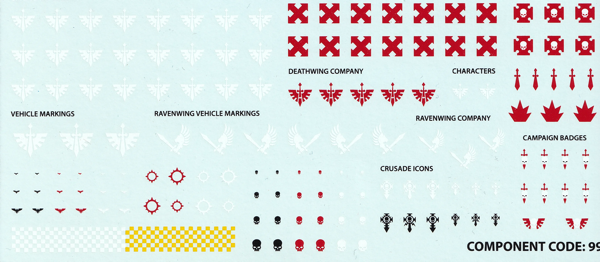
Indomitus gives the usual suspects, left and right Ravenwing logos (the the sides of the Outrider bikes the boxed set included), and several of the Crux Terminates, which goes on the left shoulder of non-Terminator Deathwing veterans (Bladeguard, Sternguard, and Vangaurd Veterans).‡ It also includes Indomitus crusade badges, small imperial eagles, iron halos, skulls, and cool checkers.

Leviathan gives us a bunch of different variations of the standard Dark Angels badge. We have some with rivets, halos, skulls, and outlined versions. None of these are “supposed” to go on any particular marine or character. Just use them however you want. I like the skull ones for sergeants and the gold ones for characters. We also get some keys, swords, and shields. Again, just sprinkle these around.
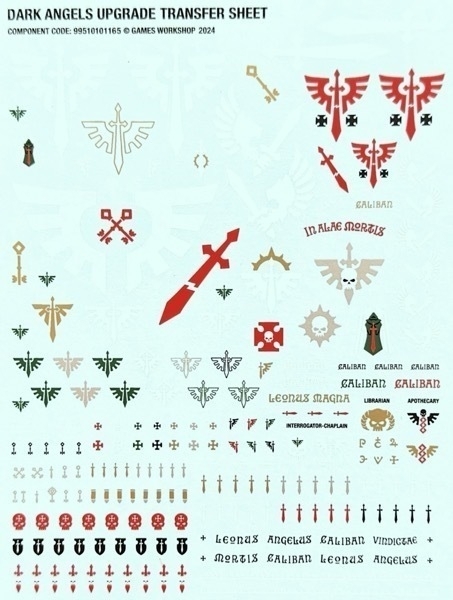
The January 2024 Deathwing Assault box includes Dark Angels symbols of assorted sizes—I’m unsure where the green ones are meant to go—generally over bone armor you’d be using red Deathwing decals. Otherwise most of the bigger decals would go on vehicles and dreadnoughts. There are a several army badge options at the bottom, swords for veterans, and cool variations of the Chaplain, Librarian, and Apothecary symbols.
I’ll update this piece when I get my hands on the sheets that come with the the next wave of releases. In the meantime, here’s the white whale of decals, the out of print Forge World sheet:
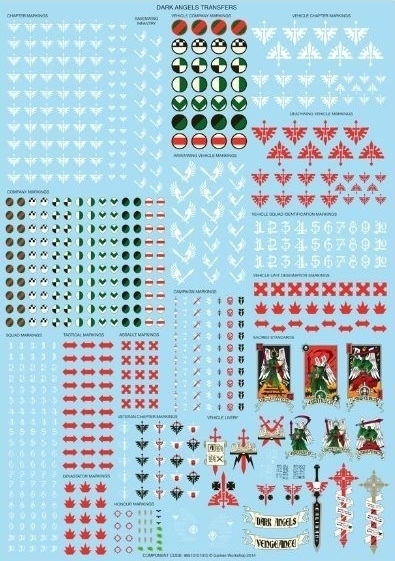
Decals for the Standards of Fortitude, Devastation, and Retribution! swoon
As some closing words, I want to suggest that transfers are a great way not just to blindly implement the “required” markings for your squads, but to add some variation to give your troops individual character. Add some text script to one marine’s leg. On another, put honor markings on either side of the chapter badge. On another, border the bottom of the shoulder pad with checkers. It can be a bit tedious but the result can be that you don’t have a squad of five or ten marlins who just look exactly the same, but instead subtly communicates that each of these battle brothers has earned individual distinctions and that their armor reflects this.
Special thanks to /u/Metal_Boxxes/ for giving me clean scans of the transfer sheets.
History:
- 24 Jan ’24: published
- 25 Jan ’24: updated with better copies of the transfer sheets, added ’89
- 3 Feb ’24: added the Deathwing Assault sheet
* For 40K. 30K Dark Angels have their own set of iconography that spans their history from their early “Uncrowned Princes” days, through their goth grim reaper phase, to the Hexagrammaton and Hekatonystika. For now we’ll focus on their “present”-day emo-core era.
† This quote is taken from Insignium Astartes, which specifically uses the Ultramarines as its template. Whether there are similar awards made from Lion El’Jonsons’s gear is indeterminate.
‡ I, like many, am not wild about the change that allows non-Terminators to wear bone armour. I have to accept that it’s valid now, but I don’t have to run them. (And yes, I’m aware that White Dwarf 129 showed a Deathwing marine in Power Armour.)
More Dark Angels stuff I’ve written:
- Shoulder Pads of the Dark Angels
- Dark Angels Apothecaries
- Why the Dark Angels Really Changed from Black to Green?
- How the Dark Angels story developed, from Rogue Trader to 2nd edition
- Successor Chapters
- My 4th company, “The Feared”
- The Deathwing: History and Complement
- Dark Angels Decals: A Look at Waterslide Transfer Sheets
- The Ravenwing, the Dark Angels’ Cavalry
-
Teammate 1.2.8
This version adds a new “Quick Score” screen that you can access from the main screen. It lets you get straight to the score sheet without having to pick a team (but without being able to record stats for that game).
The teams for Kill Team: Salvation are available as well as a new game type, Hazardous Areas, for use when playing on Bheta-Decima.
Making Teammate is always rewarding but it does take time. Please consider leaving a tip by tapping the button on the bottom-right of the main screen. Keeping the developer account open, running it as an incorporated business, etc. all does add up. Thank you.
1.2.8
- Quick Score: A new option to bring up a blank score sheet has been added to the top of the main screen. The stats for quick score games aren’t linked with any of your existing teams.
- Added Scout Squad and Blades of Khaine teams.
- Team Dataslates are now split into sections for Matched Play and Spec Ops.
- Hazardous Areas can now be picked as a game type, which will allow the Ferratonic Furnace Control Tac Op in favor of Central Control.
- Matched Play: The pre-game “Select Operatives” section can be collapsed.
- The matched play score sheet should restore scores more reliably if the app is killed in the background.
- Fixed a bug preventing Spec Ops from automatically completing Operation 2 even though its requirements were fulfilled in some cases.
- Intercession Squad: (Spec Ops) Added a confirmation dialog when you try to fail an Oath of Moment.
-
Teammate 1.2.7
1.2.7 features a completely redesigned the score sheet for Matched Play games.
1.2.7
- New score sheet for Matched Play games.
- Faction Tac Ops are now sorted by number when selecting cards pre-game. (Archetype cards are sorted alphabetically.)
- The “Elaborate Deceptions” mission from White Dwarf 492 is now available.
Finally, I will be attending the New York Open November 4–5. Teammate is an official sponsor; attendees will get a small treat in their swag bags. There’s a GT which includes an expenses-paid golden ticket to the finals in Atlanta as well as two one-day narrative events. Through November you can tap the “NY Open” button in the bottom bar of the app for more info.
-
Teammate 1.2.6
I’ve added support for Strike Force Justian to Teammate. For now I’m assuming that the team will use the Security and Seek & Destroy archetypes. If GW clarifies this I’ll have to issue an update but we’ll go for that for now.
By default, operatives on the team are named after their datacards but you can click the dice icon to randomize their name based on your preferred parent chapter. You can also use the “namesake” menu when creating the team to pick a sergeant or captain to name the Strike Force after.
This update also fixes a bug relating to deleting rare equipment, and you should now be able to dismiss the keyboard if you record notes about a game during a match.
Finally, I will be attending the New York Open November 4–5. Teammate is an official sponsor; attendees will get a small treat in their swag bags. There’s a GT which includes an expenses-paid golden ticket to the finals in Atlanta as well as two one-day narrative events. Through November you can tap the “NY Open” button in the bottom bar of the app for more info.
-
Teammate 1.2.4
Two quality of life enhancements and one wording change to comply with the new Balance Dataslate.
Operatives will remain selected for deployment between games, making starting a new game a little quicker. Also, during matched play games, I’ve added a button to hide the names of Tac Ops you haven’t scored yet so that you can show your opponent the current score screen without revealing your cards. This doesn’t apply to Spec Ops games because those score sheets have a lot more info on them. (Thanks to Bob for the suggestions.)
- When starting a new game, the operatives you selected for deployment in the previous game will remain selected. (For Spec Ops teams, operatives with battle scars will not be selected.)
- Matched Play: When scoring a game, you can now hide the names of Tac Ops you haven’t scored yet. This allows you to show your opponent the current score sheet without revealing your cards.
- Warpcoven: Updated Rubric Affinity battle honour per the 2023 Q2 Balance Dataslate.
-
The Deathwing: History and Complement
The Deathwing are the Dark Angels’ first company. Like most first companies, it is comprised of veteran battle brothers. The Dark Angels are unusual, however, in having a large enough supply of Terminator suits that they can outfit the entire company in them. But recent changes to the rules and storyline have seen power armoured marines join their ranks. With 10th around the corner and the Leviathan box including Sternguard Veterans, I thought I’d take a look at the history of the Deathwing’s development, and spell out exactly who should be wearing bone white.
TL:DR, these units are part of the 1st company and so can/should be painted bone white *:
- Terminator squads of all types
- Deathwing Knights
- Bladeguard Veteran Squads
- Sternguard Veteran Squads
- Vanguard Veteran Squads
- Dreadnoughts †
- Land Raiders †
Characters:
- All characters in Terminator Armour (Belial, Chaplains and Librarians in Terminator Armour, etc).
- Deathwing Command Squads, comprising Apothecaries in Terminator Armour ‡, Ancients in Terminator Armour, and the Deathwing Champion
- Bladeguard Ancients
Librarians and Interrogator-Chaplains are members of the Librarius and Reclusium, respectively, not the 1st Company, though they are part of the Inner Circle.
“Deathwing” In Lore and In-Game
The term “Deathwing” is used a bit loosely in some sources. It’s the name of the first company, but also a tier of membership that a Dark Angel can attain. The rules use the Deathwing keyword to give bonuses to certain units even if those units are not part of the first company. Repulsors get it, for example, because they can transport Terminators and need the keyword to be able to target them with stratagems, even though the vast majority of the chapter’s Repulsors would be “greenwing.”
A Brief Deathwing History
The Deathwing as a distinct part of the Dark Angels were introduced in the Deathwing expansion of Space Hulk. Alongside the game Games Workshop released a short story by Bryan Answell and William King that followed a small group of Deathwing Terminators who return to their home planet to find it has been infiltrated by Genestealers. Not expecting to survive, they repainted their black armor bone white, which represented death in their culture, and were able to defeat the cult. All Deathwing Terminators adopted the bone white color scheme in recognition of this feat.
This story has been retconned in two ways. First, the battle brothers in the story had a culture taken very broadly from the American Indian peoples. While a few Dark Angels models still depict feathers, a lot of this has been walked back. Second, the entire story is now considered to be apocryphal. There may not have been an actual squad that saved its home world in this way, but the story of righteous Dark Angels crushing an uprising of people they had thought to be loyal to them is now used as a fable to teach newer Dark Angels about treachery as they are prepared to learn the truth about the Fallen.
The mandate that members of the Deathwing only ever wear Terminator Armour is stated plainly in Codex: Angels of Death (1996):
Note that members of the Deathwing always fight in Terminator armour, and are never fielded as Veteran squads in power armour as is the case with most other Chapters.
The following page (37) spells out the organization of the entire chapter. For the Deathwing, its members are: Master, Chaplain, Apothecary, Standard Bearer, 20 Terminator Squads, Dreadnoughts, Land Raiders.
Deathwing Knights came along in 2012. Belial was also promoted to the head of the Deathwing, and the story from “Deathwing” is now listed as an “Apocryphal Tale.” Company Champions are a new character type around this time, getting a model in the plastic Deathwing kit.
A few years later, GW began to greatly expand the Horus Heresy-era lore, inserting the Deathwing as one of the six wings of the original chapter, many of whom were veterans who served as honor guards. With the “Deathwing” story out of canon, the bone white color scheme was given a new origin: a battle brother who took a blow meant for another was allowed to repaint that part of his armor white.
Through 9th edition, Dark Angels lists were explicitly forbidden from taking Sternguard Veteran and Vanguard Veteran squads, but the new Bladeguard Veteran and Bladeguard Ancient units were given the Deathwing keywords. At the time GW was keeping Primaris and firstborn units strictly separate. Terminators were firstborn, so there was nowhere for Dark Angels to stick their Primaris veterans. Thus, the Deathwing for the first time was able to field models in power armour.
(There was also a matter of practicality here. The Bladeguard models came in the Indomitus launch box. GW’s choices were either 1) forbid Dark Angels players from using the models they’d just bought, 2) make BGV company veterans in green, or 3) allow power armour in the Deathwing. Option 1 doesn’t make commercial sense and would feel bad. Option 2 probably would have been fine. GW went with 3 and changed the lore.)
In 10th edition, GW has decided to relax the Primaris/firstborn distinction, and has outright said that Primaris marines can wear Terminator Armour. Meanwhile, Sternguard Veterans are included in the Leviathan box, with Deathwing transfers for their left shoulders and the Crux Terminatus for their right. No in-story explanation has yet been given for this change. The 10th edition Dark Angels supplement also gives Vanguard Veterans the Deathwing keyword.
[19 Jan ’24: updated for 10e.]
* Unless you’d rather paint them in a different color scheme. They’re your models after all! See also my piece on successor chapters, which don’t all put their veterans in special colors. ↩
† Dreadnoughts and Land Raiders can, of course, also serve other companies, in which case they’d be green. In 10th edition they get the Deathwing keyword regardless of their color scheme but I think it makes sense for them to match the company they’re serving in. ↩
‡ See here for more on apothecary paint schemes. My preference is that the Apothecary retain the cold white of his office with a bone white shoulder pad, but you could paint him all bone white if you prefer. ↩
More Dark Angels stuff I’ve written:
- Shoulder Pads of the Dark Angels
- Dark Angels Apothecaries
- Why the Dark Angels Really Changed from Black to Green?
- How the Dark Angels story developed, from Rogue Trader to 2nd edition
- Successor Chapters
- My 4th company, “The Feared”
- The Deathwing: History and Complement
- Dark Angels Decals: A Look at Waterslide Transfer Sheets
- The Ravenwing, the Dark Angels’ Cavalry
-
Teammate 1.2.3: Ashes of Faith
Teammate 1.2.3 adds support for Kill Team: Ashes of Faith. And the Gallus Campaign is in full swing. It’ll run through June so there’s plenty of time to jump in and play the missions.
I did have to turn off team validation for Inquisitorial Agents. Normally when you make a new Spec Ops team or when you’re picking operatives for a game, Teammate will automatically disable operatives that are not eligible based on your current choices. It won’t let you pick two snipers, or two leaders, for example. But with all the ancillary support options, the Inquisitorial Agents team is just too complicated and running the validation was slowing everything down tremendously. I’m not happy about it and I’ll try to see how I can make it run more efficiently, but I didn’t want to delay the release any more.
1.2.3:
- The Inquisitorial Agent and Chaos Cult teams are now available.
- When creating a new team, if that team has required operatives with no wargear options, those operatives will be created automatically (Pathfinder, Elucidian Starstrider, Gellerpox Infected, Hierotek Circle, Inquisitorial Agent, Chaos Cult).
- Spec Ops: The In Memoriam screen now shows the XP and rank of your slain operatives.
- Spec Ops: Slain operatives can now be revived using a button on the In Memoriam page. Resurrect responsibly.
- Void-dancer Troupe: Added the Recon archetype, which had been missing erroneously.
-
Teammate 1.2.2
Teammate 1.2.2 adds support for Kill Team: Gallowfall.
For Spec Ops games, Critical Ops cards will now be automatically counted as their core deck counterparts. The text of Spec Ops is unchanged. A mission that wants you to score, say, Triangulate, will still say that, but if you pick Outflank you’ll get credit for it, and in that example Outflank will have an icon next it to show it counts for the active Spec Op. Hopefully everything should just work.
(Special thanks to Travis for the official BStrat card mappings. It’s good to have a second eye on these things, absent proper guidance from GW.)
1.2.2 (28):
- The Hearthkyn Salvager and Fellgor Ravager teams are now available.
- Added Gallowfall missions.
- Spec Ops: All Critical Ops ’22 cards have been mapped to Core Deck Tac Ops for the purposes of scoring Spec Ops. If you play a game using Critical Ops cards, your progress in your Spec Op will be updated automatically.
- Fixed a typo in the “Subversive Control” Tac Op’s name.
- Hand of the Archon: Fixed a bug that caused the app to crash if you complete the Remove Rival Spec Op.
- Greenskin: Removed incorrect wargear options from the Boy Fighter operative.
-
Just Another Kill Team Podcast: Narrative Episode with David Ely
Jason and Travis were nice enough to have me on their show to talk about Teammate and narrative play in general.
-
Dark Angels 4th Company, "The Feared"
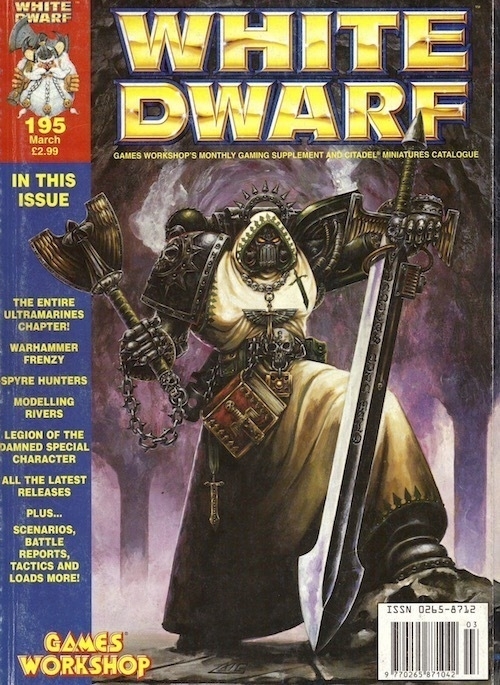
Issue 195 of White Dwarf magazine came out in early 1996. I had recently started playing Warhammer 40,000, and this issue was a big deal in two ways. First, it had a cool cover featuring Asmodai, and I had recently started playing Dark Angels. Second, on page 81 there was a feature showing the entire chapter of the Ultramarines. This seemed absolutely mad to me—over 1000 Space Marines!
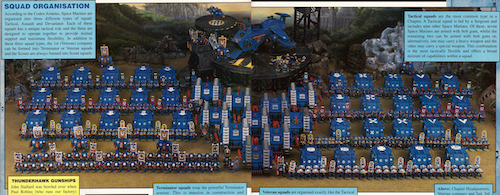
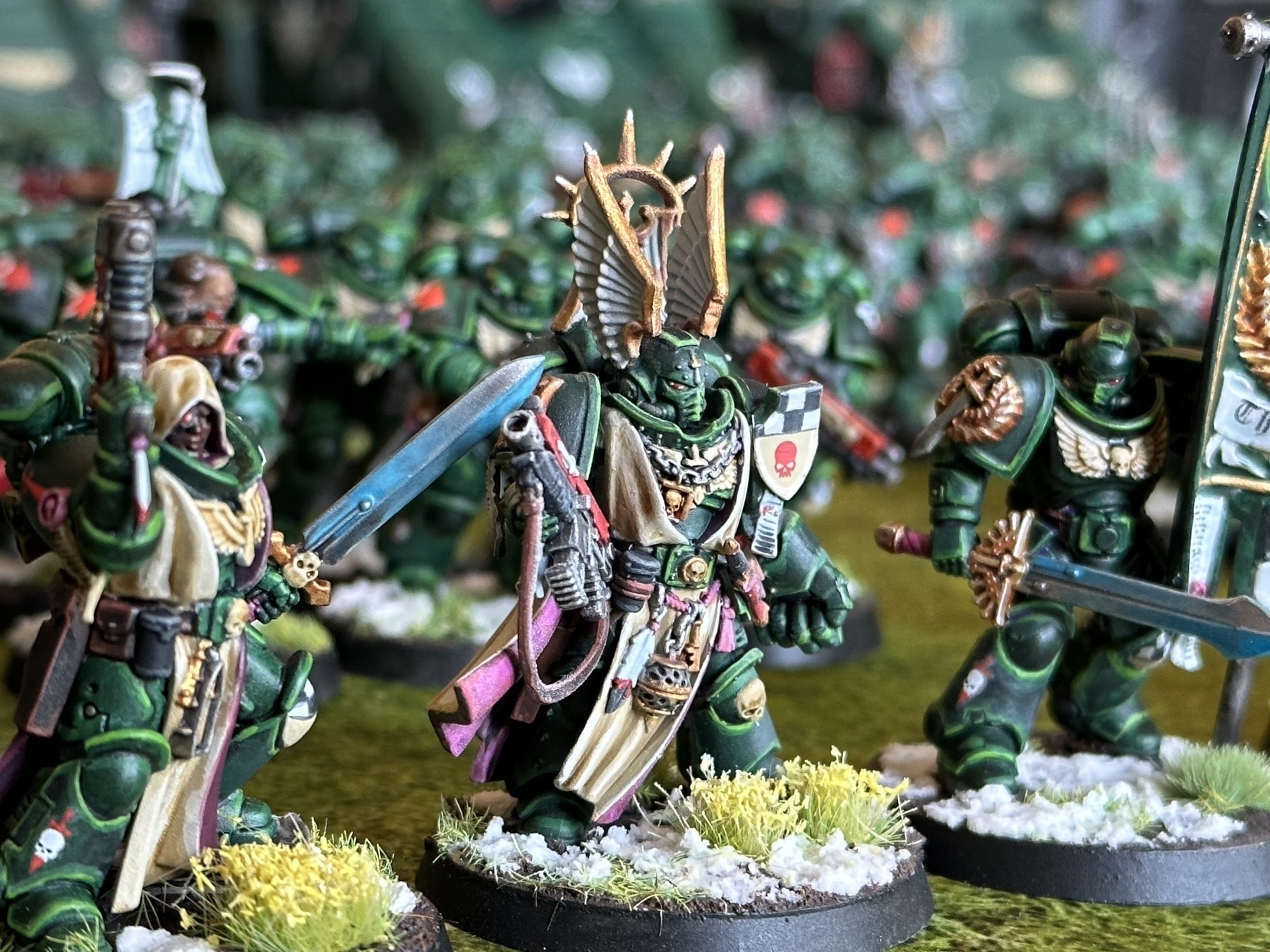
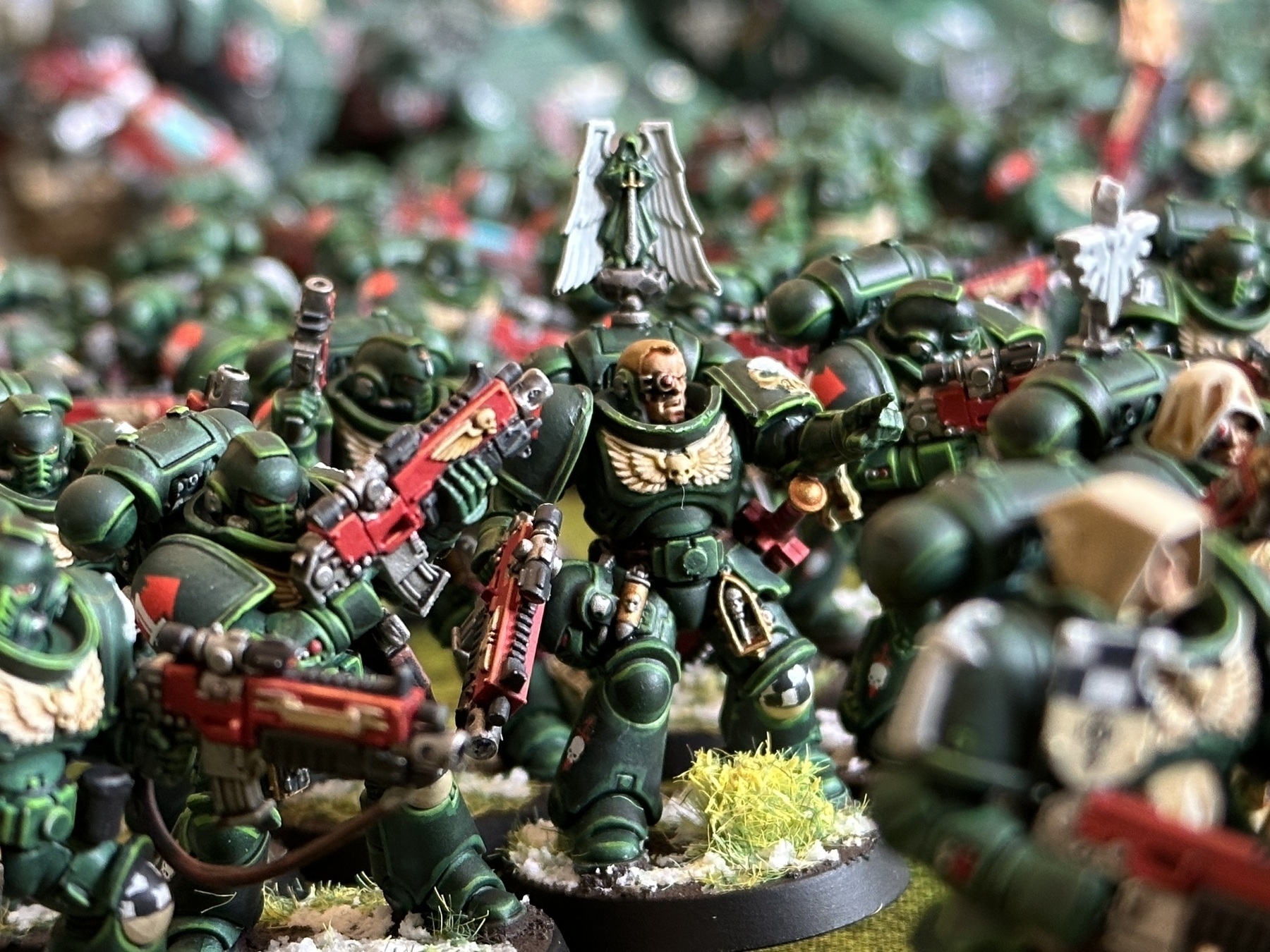
Well, I’m not there yet, but I’m excited to now be able to show off an entire battle company that I’ve painted. Allow me to present the Dark Angels’ 4th company, “The Feared.”
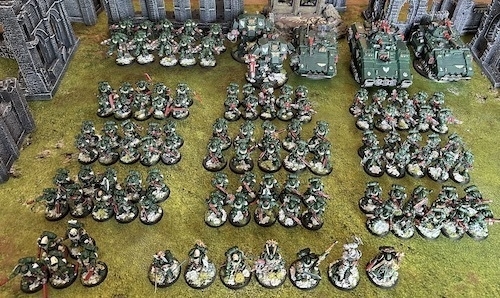
(Click images to enlarge)
The Feared are entirely codex-compliant: six battleline squads (40 Intercessors, 10 Heavy Intercessors, 10 Infiltrators); two close support squads (10 Inceptors, 10 Assault Intercessors); two fire support squads (20 Hellblasters)
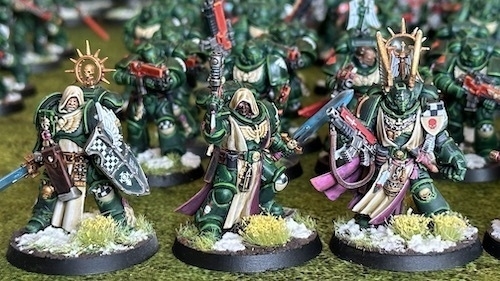
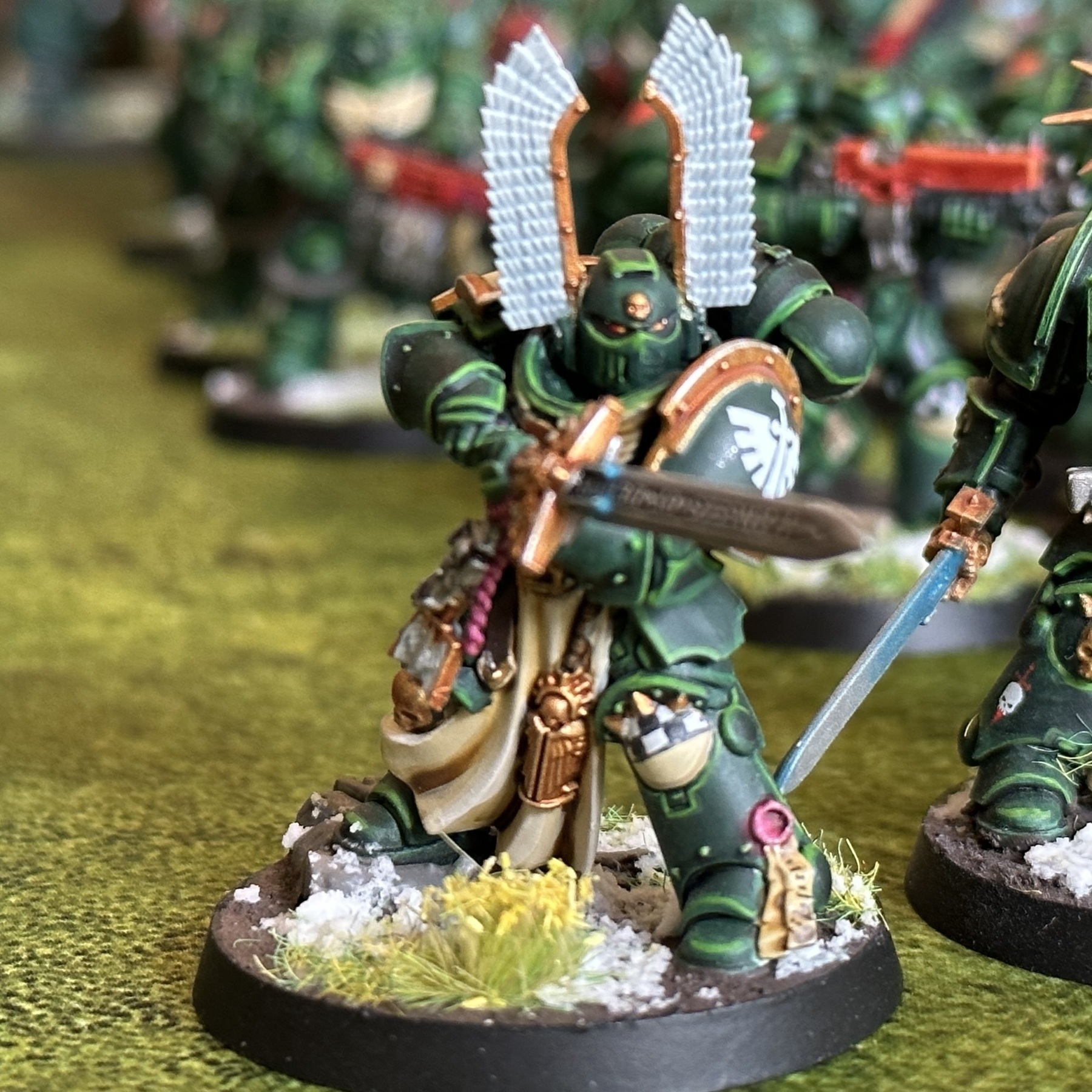
They are led by Company Master Larathiel Adellum and his two Lieutenants, Astrovel Soriel and Yofiel Seraphus, made from the Dark Angels Captain kit, the Dark Angels Lt kit, and the Warhammer Day Primaris Lt (kitbashed with the shield from the Forgeworld Dark Angles Praetor and a few other bits).
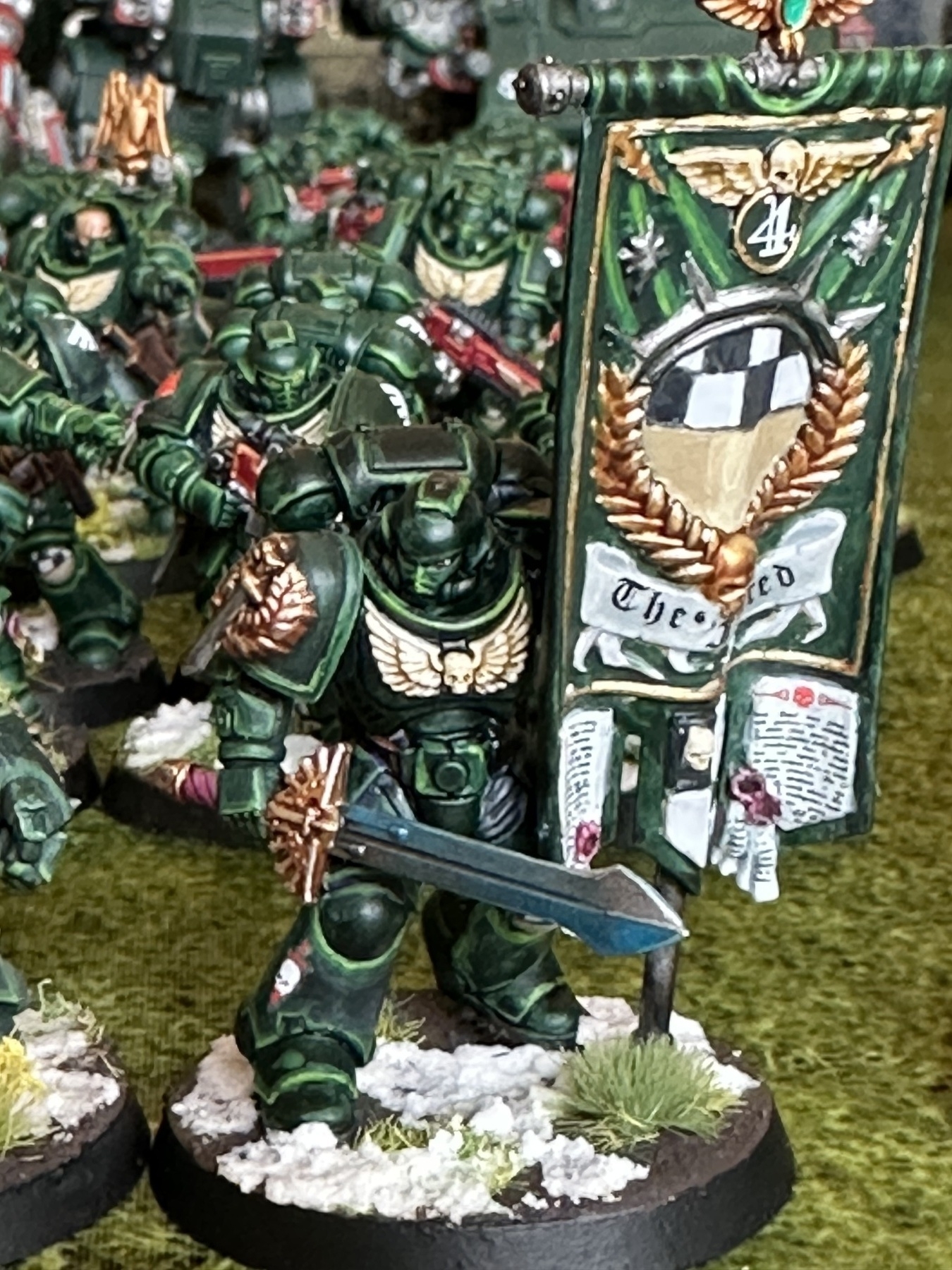
The command squad consists of a Company Ancient, chaplain, champion, apothecary, and five Veteran Intercessors.
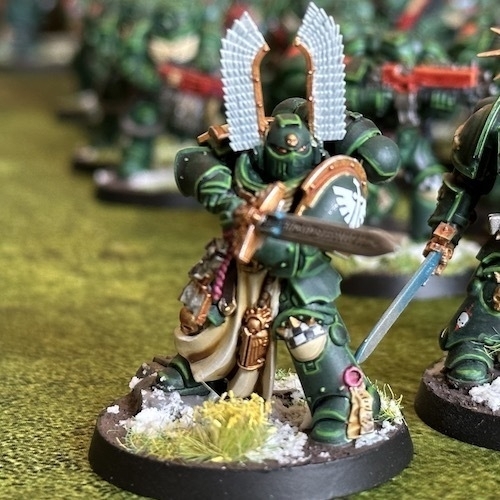
The Company Champion is last year’s limited edition Primaris Champion kit. The wings on his helmet were carefully shaved off the piece from the firstborn upgrade sprue. The sword comes from that kit, too.
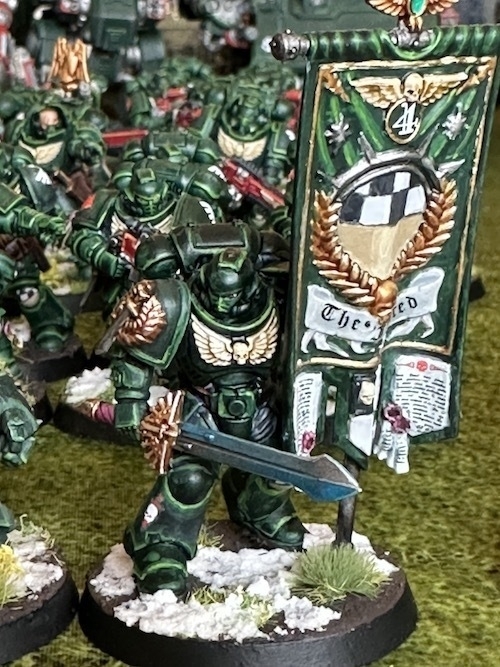
The Ancient has a laurel on his shoulder, which comes from the Dark Angels veterans box, and has a Dark Angels sword, too. The traditional heraldic device for a marine fourth company is the chief (half and half top/bottom). The Dark Angels bling theirs up with some checkers. You can see it on his banner. The gem at the top is green, a nod to the traditional color of the 4th company. Purity seals throughout are transfers from Forgotten Chapters.
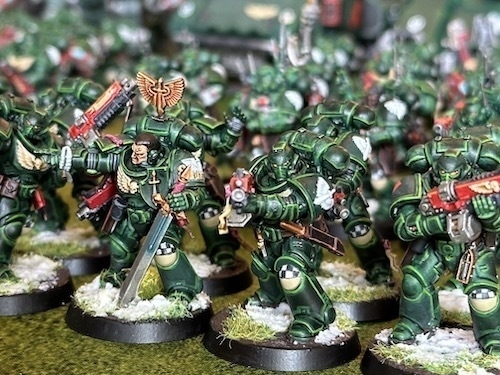
Yes, this did mean hand painting over 100 knee checkerboards. Some look better than others. (Ska may have faded with the 90s, but the two-tone army is still here on my table! Though Dark Angels would hate ska—they only listen to emotional hardcore.)
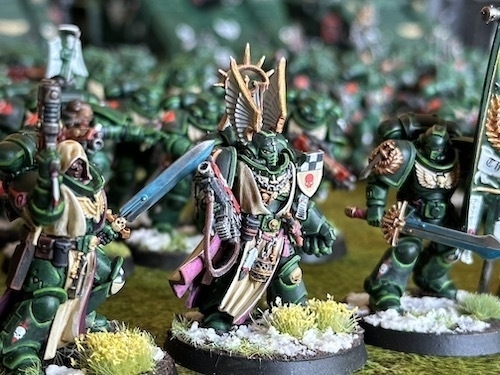
Every model has a crusade badge—the red sword with a skull—on the right greave.
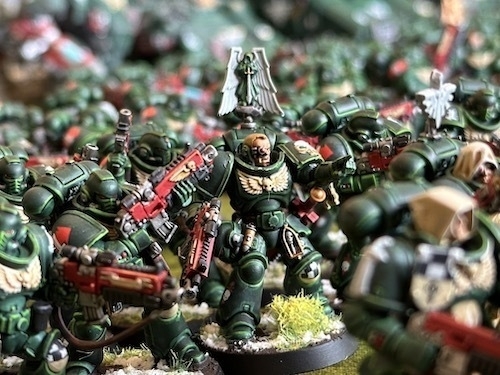
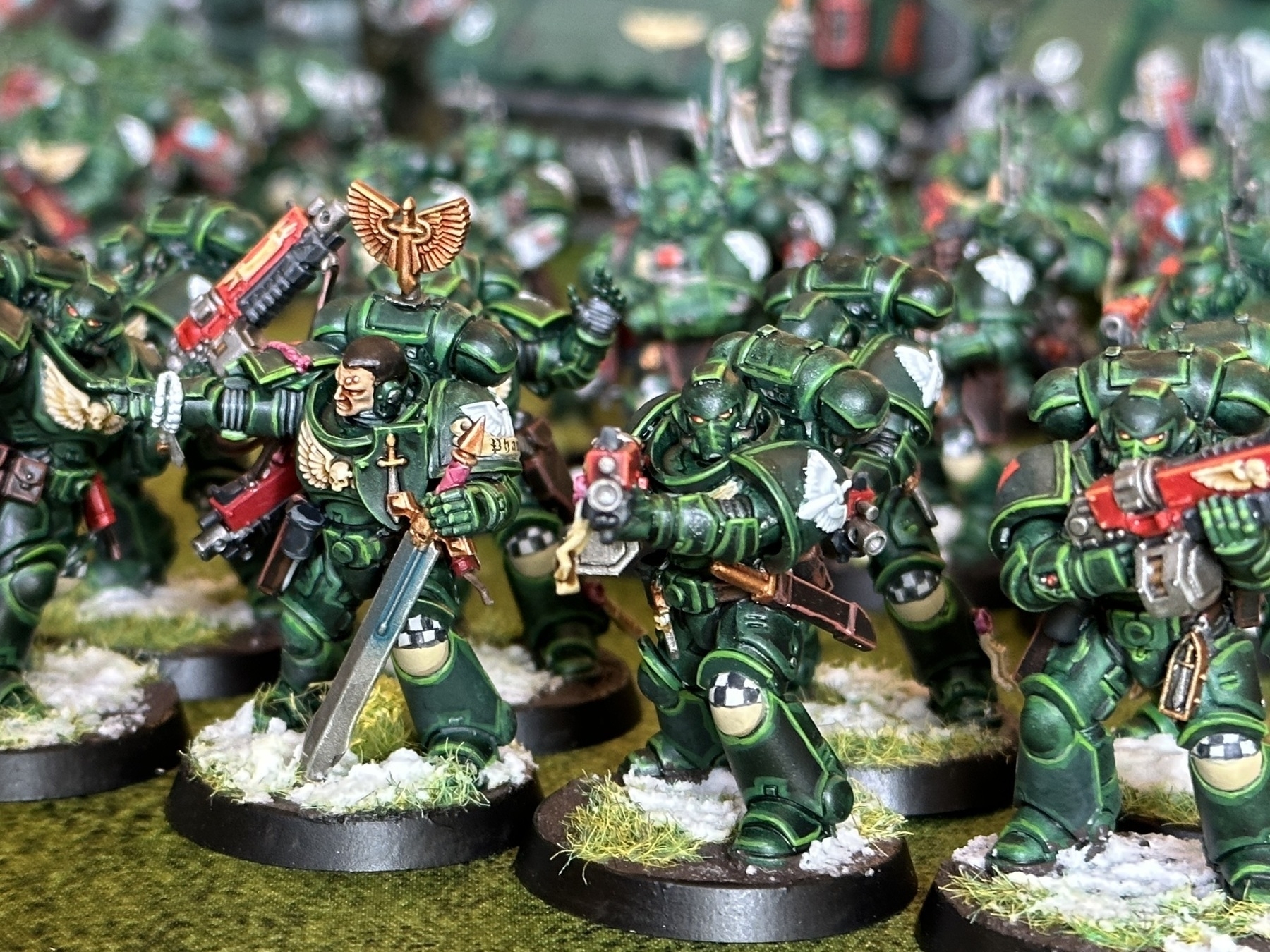
Sergeants have bare heads and flowers on their base. Everything is organized around 10-man squads. When I field them in a game, squads are usually broken up and grouped as five, so each set of ten has a battle brother with a sword on his helmet who leads the second squad. This let me use all the sergeant poses. The bare heads are also (nearly) all from Dark Angels-specific kits.
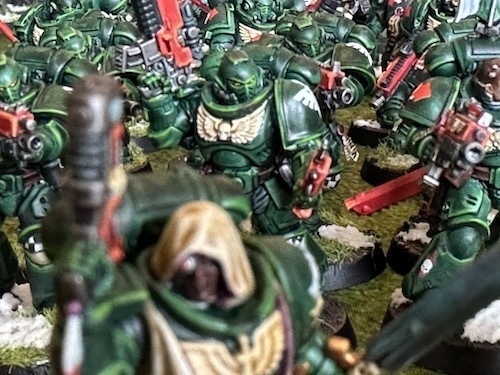
Dark Angels don’t recruit from any one particular world, so I worked to vary their skin tones across the army. Most everything is done with Contrast paint, from armor to robes to faces.
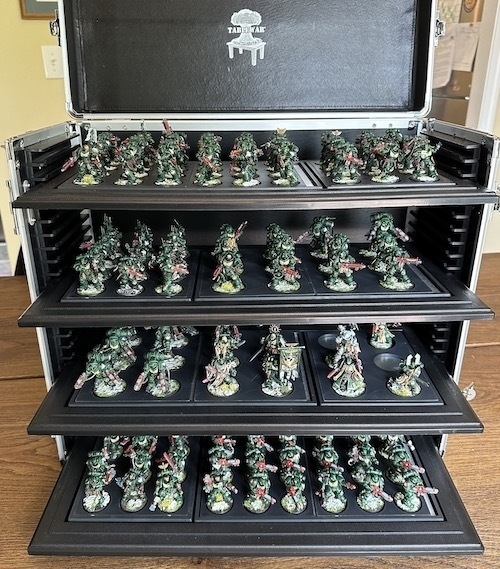
Excepting the dreadnoughts and tanks, the whole company fits in one full-size Table War case.
Using current point values, the company comes to 3855 points.
Not pictured are several thousand more points of Ravenwing, Deathwing, the entire Phobos army I took to NOVA last year, Aeronautica Imperialist Dark Angels, and some Heresy models I’ve started. My “pile of shame” is shrinking but I still have a bit more to finish. Up next is the new Azrael model.
More Dark Angels stuff I’ve written:
- Shoulder Pads of the Dark Angels
- Dark Angels Apothecaries
- Why the Dark Angels Really Changed from Black to Green?
- How the Dark Angels story developed, from Rogue Trader to 2nd edition
- Successor Chapters
- My 4th company, “The Feared”
- The Deathwing: History and Complement
- Dark Angels Decals: A Look at Waterslide Transfer Sheets
- The Ravenwing, the Dark Angels’ Cavalry
-
Teammate 1.2.1
Teammate 1.2.1 brings compliance with the newest Balance Dataslate.
If your game uses the Critical Ops cards, the maximum a player can score is now 24. GW has not officially removed the 20-point max, but this way if they do affirm it’s supposed to be 24, everything will work, and if they instead say it’s still 20, you can just not give yourself more than 20 points. I also put a max on the scoring steppers so that both players’ mission scores can never add up to more than 24.

- In games using the Critical Ops mission pack, players can now earn up to 16 points on the primary score. The scoring buttons will prevent both players’ primary scores from summing to more than 24.
- In games using the Critical Ops mission pack, the maximum score is now 24. [This may change in a future update if Games Workshop affirms that the max should remain at 20.]
- Kasrkin: Added Combat Blade equipment.
- Kommando: Teams that include both a Grot and a Bomb Squiq can now pick 11 operatives.
- Phobos Strike Team: Updated the Guerrilla Battle Honour to match the Balance Dataslate.
-
Teammate 1.2
1.2 adds automatic* support for Spec Ops† and Mission bonuses‡. I’m incredibly happy with how it works: just play your games, pick your mission and Tac Ops§, and it handles everything for you. Before, it was easy to simply not notice that you’d fulfilled the criteria to receive a mission bonus, or to forget to update your progress in an operation. But since the app already knows all that stuff—what Spec Op you’re on, what cards you picked—it can just do it for you. Reducing the need for you to be the one doing that sort of bookkeeping was the whole reason I build the thing.
This update is a bit of landmark in that it more or less rounds out all the basic functionality of the app. Development on it will continue, of course, and new teams and balance patches will go in, but it’s now at a place where I think it’s satisfyingly full-featured. The goal was always to remove as much of the bookkeeping and tedium surrounding managing your team.
I’m sure there are bugs because coding in all of those Spec Ops and missions was a ton of work. Please reach out if you find behavior you don’t expect.
* It’s automatic wherever it can be, but the app obviously doesn’t know the physical state of the board. If a mission wants to know if you ended the game with operatives in your opponent’s deployment zone, for example, you’ll have to tell it whether you achieved that or not.
† Confession: there are small handful of Spec Ops I simply threw my hands up and gave up on. Warpcoven’s Labyrinthine Plans—because every single aspect of Warpcoven requires custom code—and the Void-dancer Spec Ops that wanted too much stuff about your performance. You’ll have to advance those manually.
‡ Only the pre-built narrative missions from the books are supported. If you’ve written custom missions you can of course decide what bonuses to give your players and have them award themselves RP, XP, etc. manually.
§ Big caveat here: out of the box, Spec Ops are designed to work with Tac Ops from the Core Book. I’ve ported all the cards that have obvious analogues in the Critical Ops deck over, but if you’re playing with Critical Ops, you might find that some cards aren’t scored automatically. If GW ever provides guidance on how to map the cards, I’ll add support, but I don’t want to go off on my own on this one. You can always manually adjust your progress in an operation on your team’s page.
Full release notes:
- Automatic tracking for (nearly all) Spec Ops
- Missions: You can now select which mission you’re playing
- Mission bonuses: If you select a pre-made narrative mission, its Mission Bonus, Tac Ops Bonus, and/or Spec Ops bonuses will be applied if you meet their criteria.
- The list of team data slates can now be sorted by team name or by faction.
- Most places where rare equipment can be added now let you add a random piece of equipment as an option.
- It should no longer be possible to acquire duplicates of rare equipment.
- Spec Ops teams can now choose “Strict Equipment Drops.” If enabled, the Equipment Drop requisition will enforce that items are bought in groups of 5 EP. Unused EP is wasted. (Off by default.)
- Added Undo functionality to the Equipment Drop button.
- Warpcoven: A symbol will appear next to Sorcerer operatives that haven’t picked their Boons or Psychic Disciplines.
- Hierotek Circle: A symbol will appear next to Cryptek operatives that have not picked their Cryptek Actions.
-
Teammate 1.1
1.1 adds the Soulshackle teams, Hand of the Archon and Exaction Squad, as well as game history and stats. The stats page shows your overall win rate, win rate vs each other faction, and tracks the average victory points you score for each different Tac Op card.
1.1 (23)
- Added Exaction Squad and Hand of the Archon teams.
- Clicking on a battle honour or battle scar on the in-game view now brings up a sheet describing that honour/scar.
- Games History and Stats added to each team’s info (for games played on this version forward).
- Clicking on a battle honour on the operative’s datacard now shows a confirmation message reminding you to check whether you’re allowed to change this honour before doing so.
- The close quarters switch on the pre-game screen will now set itself to whatever your last game was.
- Added a few options to the menu when you right click/long press on an operative in the team list.
- Elucidian Starstriders: Family Chronicle asset only displays on the datacard for Elucia Vhane.
-
Teammate 1.0.3
Hot on the heels of 1.0.2 comes 1.0.3, which fixes a small bug for teams using the accelerated ranks custom rule, and adds in some UI for a few assets.
1.0.3 (22)
- Enhanced support for the War Shrine and Stimms Stash Strategic Assets.
- Expanded Supply Bay (Imperial Navy Breachers) and Vermin Nest (Gellerpox Infected) assets now show the extra items in the stash.
- Cleaned up the text formatting for some strategic assets and battle honours.
- Fixed a bug where operatives in Spec Ops teams with accelerated ranks wouldn’t be shown their battle honour options at the right XP tier.
-
Teammate 1.0.2
Teammate 1.0.2 is available now.
This version adds support for most faction-specific Requisitions and Strategic Assets, all universal Requisitions, Medic re-rolls, and the Med Bay Strategic Asset. You’ll find buttons for all of these in the appropriate places in the app. For example, if an ability allows an operative to re-roll a casualty test, there should now be a menu item next to the failed test’s result. If a Requisition is applied after a game, it will appear at the bottom of the post-game screen if its conditions have been met.
Of the 57 faction Requisitions, Teammate now supports 53! The remainder tend to be ones that involve in-game effects that the app doesn’t concern itself with, or those dealing with Spec Ops Commendations. You can still of course manually adjust your RPs when you want to activate these. These are: Negotiate, Debt Owed (Farstalker Kinband); Negotiate (Elucidian Starstriders); Mark Assigned (Hunter Clade); Grand Role (Void-Dancer Troupe).
Since so many of these require recognizing very particular circumstances, there’s a fair chance I’ve missed a few. Please let me know if you find any bugs or strange behaviors: mastodon.social/@davextreme.
1.0.2 (21)
- Added support for the Recuperate and Medivac requisitions in the appropriate menus on the post-game screen.
- Medivac’d operatives are required to sit out one game before they can be selected for deployment. You can override this by turning off list validation on the pre-game screen.
- Proficient Operative, Weaponsmith requisitions now have buttons on individual operatives’ pages when they reach the correct rank.
- Added support for nearly all faction requisitions.
- If you have the Med Bay Strategic Asset, an option will appear in the casualty menu after rolling a test.
- Medic re-rolls are now an option in the casualty test menu if your team deployed a medic that wasn’t incapacitated.
- All faction strategic assets that affect things Teammate tracks—XP, injury rolls or adjustments—are now handled automatically if they’re part of your base of operations.
- Added a new menu for scoring Tac Ops on the in-game screen—you can now score them in the list of Tac Ops or on each operative’s entry.
- Taking a Tac Op that requires an operative to be selected before the game starts (Deadly Marksman, Interloper, Plant Banner) now presents the option to pick that operative.
- Re-rolling a casualty, battle scar, or recovery test will now show a confirmation dialog to remind the player to check the rules and be sure this test is allowed to be re-rolled.
- Operatives that roll a 1 for their battle scar test are no longer marked as slain until after you finalize the game. This gives time for you to re-roll or use Recuperate before they’re moved to In Memoriam.
- Legionary: Marks of Chaos added to the pre-game operative selection list.
- Warpcoven: Randomly-selected Boons of Tzeentch can now be any boon (even if an operative already has that boon)
- Warpcoven: The button for adding a second boon (for Sorcerers) and a first (for Tzaangors) now only shows if the Boon/Mutation battle honour has been chosen.
- Warpcoven: Changing a battle honour to an honour that’s not Boon/Mutation will delete the previous boon that had been gained.
- Warpcoven: Boons and psychic disciplines added to the operative’s entry on the in-game screen.
- Reduced the disk space operative images take up.
- iPad: Fixed a few confirmation dialogs that had become detached from their buttons.
-
Dark Angels Successors Chapters
I’ve written before about heraldry and markings for Dark Angels Space Marines in Warhammer: 40,000. Today I’ll go over successor chapters. There are a number of named chapters that Games Workshop has developed, so you’re free to use one of those, or make up a new one entirely.
Organization
Some Dark Angels successor chapters are going to hew closely to how the parent chapter is organized and operates. Some could be totally different. There are even brand new Ultima Founding chapters that don’t even know anything about the Fallen and just go about doing normal Space Marine things.
By default I would recommend that your chapter follow the Codex Astartes, or a modified version like the Dark Angels use—ten companies of 100 marines plus command personnel. Whether you use colored helmets and company colors or Dark Angels-style heraldic devices is up to you.
Note that successor chapters that use Dark Angels-style kneepads to designate their companies tend to use the model’s right kneepad (not left).
Your chapter can have Deathwing or Ravenwing analogues, but it doesn’t need to. Perhaps your chapter master distributes knowledge of the Fallen throughout the companies to trusted veteran sergeants. In-game you’ll still only get the Deathwing keyword on the appropriate squads, but the story is yours to make up. Likewise with the Ravenwing. You can have the bikes be part of normal companies, not all grouped together in the 2nd.
Colors
Successor Terminators and bikes can be the same color as the rest of your army; they don’t need to be different like with the Dark Angels. If you do want to give them their own color schemes, I recommend picking your palette with this in mind. Use the secondary color on the main troopers as the primary color on the veterans. Or just mark your Deathwing-equivalent with, say, gold trim instead of black. There are plenty of ways to distinguish them.
The Unforgiven
2nd edition Angels of Death codex:
The three Space Marine Chapters shown here and the Dark Angels Chapter comprised the original Dark Angels Legion before the Second Founding. […] Collectively the four Chapters are known as the Unforgiven. The Angels of Absolution, the Angels of Vengeance and the Angels of Redemptionm share the ancient secret of the Dark Angels and that Chapter’s mission to reclaim its honour and eradicate the terrible shame of their part in the history.
The three Chapters follow the Dark Angels’ pattern of organization closely and each has its own Inner Circle. They all have formations which are similar to the Deathwing and Ravenwing companies although they are not named as such. The Chapters of the Unforgiven coordinate their activites in regard of their secret mission and it is not unknown for the Supreme Grand Masters of the four Chapters to hold summit meetings on the Rock.
Angels of Absolution: Accoding to Angels of Death, “all of the Chapter’s warriors wear bone-white armour.” This would include its Deathwing and Ravenwing analogues. Their robes are green. Their backpacks are black in earlier codex art but white in some. Their inner circle is called the Hidden Brotherhood.
Angels of Vengeance: “The First Company wears black Terminator armour and the monkish robes of the Inner Circle are jet-black.” Some GW studio models have red tabards. Squad markings are inverted from Dark Angels—white with red numbers. “The Angels of Vengeance use a Terminator-armoured company known as the Dreadwing and a mobile Raptorwing to carry out the hunt for the Fallen (8th ed codex, page 45).
Angels of Redemption: Red Robes. “The Angels of Redemption have the Redwings, their 1st and 2nd companies” (ibid).
Other Named Successors
Guardians of the Covenant wear red robes. Their bikers use the same silver colors as their battle companies, with some red panelling. Very monastic in their styling—probably hard to do these days without Primaris-sized robes but one could maybe use Black Templar pieces. Their inner circle is known as the Secret Order.
Consecrators used to only wear MK VI armor but now have Primaris members. Their robes are red. Squad markings are inverted from Dark Angels—white with red numbers. Terminators wear white helms per the novel The Unforgiven.
Disciples of Caliban’s Terminators wear the same green and black as their battle company do. They have lots of relics so I’d recommend some cool ancient conversions. White/bone robes.
Angels of Defiance have quartered black and bone armor. Black on the models’ upper-left and lower-right, bone on the top-left and bottom-right. Green robes.
That’s just a few of the ones GW has made up. If I were starting over I’d probably so a codex-style chapter with black armor like the Heresy scheme. For ease I’d likely also try to use regular SM models so that I wouldn’t have to source chapter-specific parts.
More in this series:
- Shoulder Pads of the Dark Angels
- Dark Angels Apothecaries
- Why the Dark Angels Really Changed from Black to Green?
- How the Dark Angels story developed, from Rogue Trader to 2nd edition
- Successor Chapters
- My 4th company, “The Feared”
- The Deathwing: History and Complement
- Dark Angels Decals: A Look at Waterslide Transfer Sheets
- The Ravenwing, the Dark Angels’ Cavalry
-
Teammate 1.0.1
Teammate 1.0.1 is available now.
The big features are enhancements for people who primarily do Matched Play games, and list validation.
When you create a new team, you can now choose whether your roster will be used for Matched Play or for Spec Ops. If you pick Matched Play, the app will hide all the Spec Ops features and will just let you make a list and keep score in games. I think that for basic Kill Team list-building and sharing it’s the best option out there.
List validation (for non-Compendium teams) means that when you create a new Spec Ops team, the app will make sure your starting roster is legal. If your team only allows you to take a certain number of a given operative (ex. one leader, one plasma gunner), Teammate will disable the ability to select more once you’ve hit your limit. This also works when you start a game—start selecting operatives and invalid choices will dim. You can turn this off if you don’t want it, which might be needed if you’ve written a narrative scenario requiring something unusual.
Tac Ops scoring has been improved a little, too. Some cards, like Rob & Ransack, require the operative who scored to the first bullet point to also score the second. In this case, the second bullet is now a toggle switch, which prevents you from assigning that point to the wrong operative. Other cards, like a few for Warpcoven, can only be scored by a specific operative type. The list now limits itself to just valid operatives. And for Matched Play rosters, Tac Op scoring is just a series of switches now. No need to designate the operative who scored it, since XP isn’t a factor.
Going forward, should an operative pay the ultimate price and roll a 1 for its battle scar test, you can visit the “In Memoriam” page to remmeber their sacrifice. There’s even a notes field where you can fill in some details aobut your departed operative’s demise.
New Spec Ops teams can also set custom campaign rules to increase XP generation and/or decrease the XP needed to level up.
Release notes:
- Matched play teams: When you create a new team you can now designate it as a Matched Play list, which will hide all Spec Ops features.
- List validation: New non-Compendium rosters will now prevent you from taking an illegal initial list.
- Pre-game team selection: Added an option to validate the list as you select operatives.
- Custom campaign rules: When creating a Spec Ops team you can now adjust how much XP operatives get in a game and/or how quickly they gain ranks.
- “In Memoriam”: Slain operatives now have a resting place in the team’s Info section. (This only collects operatives slain since upgrading to this version.)
- Tac Ops: Cards that are “all or nothing” will now automatically fill in both bullet points when scored (Interloper, Plant Signal Beacon, Blow It Up!)
- Tac Ops: Cards that require the same operative to score both points will now prevent you from selecting different operatives (Escort Operative, Rob and Ransack, Executioner, Courier, Challenge, Hero’s Path, Champion of Mankind)
- Tac Ops: Cards that can only be scored by a specific operative type will now only allow you to score them with an appropriate operative (Reputation to Maintain, Investigate Motive Force, Scry Secret, Sorcerous Ritual)
- Added an option to make a copy of a Spec Ops team as a new Matched Play team (and vice versa)
- When you first create a roster, a confirmation dialog now appears to make sure you know it’ll cost RPs to add operatives going forward.
- Fixed a bug where adding an operative that has no wargear options wouldn’t cost RP.
- Fixed a bug where deleting a strategic asset would sometimes try to delete the wrong asset
- Fixed a bug where Cerebral Affliction battle scars would persist after a game’s end.
- Revised the formatting of exported rosters.
- Greenskin: Added Boy Gretchin operative.
- Warpcoven: Team selection will now determine whether security or recon Tac Ops has the star next to it.
- Elucidian Starstriders: Elucia Vhane canned be added to your roster if you already have one on your roster.
- Gellerpox Infected: Vulgrar Thrice-Cursed cannot be added to your roster if you already have one on your roster.
- Legionary: Marks of Chaos are now color-coded
- Legionary: The new operatives menu now disables the Balefire Acyolyte choice if the operative’s mark is Khorne, rather than hiding the entry entirely.
- Legionary: Dark Desecration is now disabled for close quarters games.
- Hierotek Circle: Epithets are now combined with the operative’s given name so they alphabetize more sensibly.
- Kommando: Blow it Up! is now disabled for close quarters games.
- Imperial Navy Breachers: C.A.T. Units and Gheistskulls no longer default to having human names.




subscribe via RSS